Student Handbook
Revised August 2018
The Transylvania University Student Handbook is adapted from the NCHERM Group
Model Developmental Code of Student Conduct, 2018, and is used here with permission.
www.ncherm.org
�
2
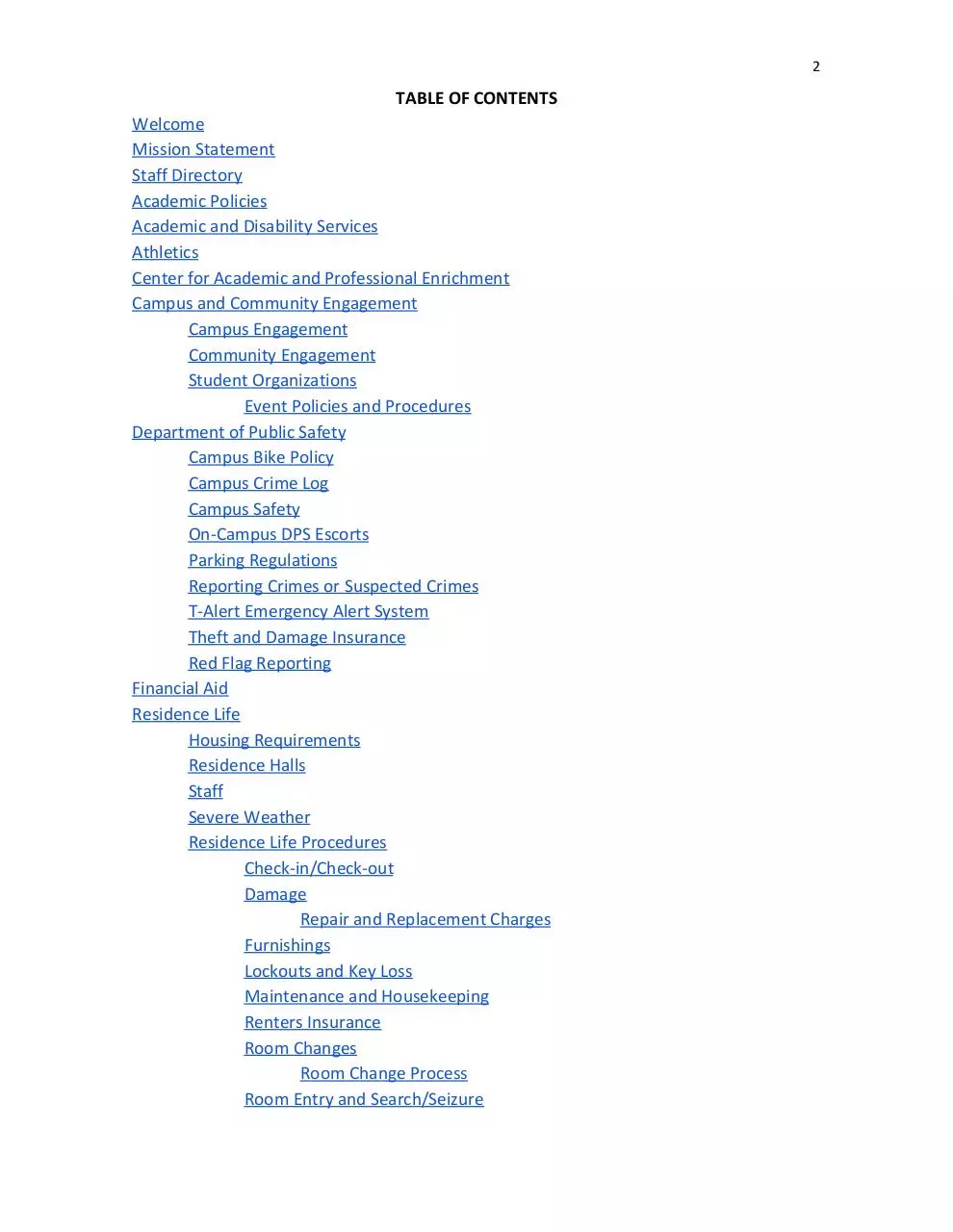
TABLE OF CONTENTS
Welcome
Mission Statement
Staff Directory
Academic Policies
Academic and Disability Services
Athletics
Center for Academic and Professional Enrichment
Campus and Community Engagement
Campus Engagement
Community Engagement
Student Organizations
Event Policies and Procedures
Department of Public Safety
Campus Bike Policy
Campus Crime Log
Campus Safety
On-Campus DPS Escorts
Parking Regulations
Reporting Crimes or Suspected Crimes
T-Alert Emergency Alert System
Theft and Damage Insurance
Red Flag Reporting
Financial Aid
Residence Life
Housing Requirements
Residence Halls
Staff
Severe Weather
Residence Life Procedures
Check-in/Check-out
Damage
Repair and Replacement Charges
Furnishings
Lockouts and Key Loss
Maintenance and Housekeeping
Renters Insurance
Room Changes
Room Change Process
Room Entry and Search/Seizure
�
3
Room Selection
Single Rooms
Study Abroad Housing
Summer Housing
Residence Life Services
Laundry Facilities
Storage
Study Lounges
Trash and Recycling Disposal
Student Life
Services and Resources
Bookstore
Campus Mail
Crimson Card
Dining Services
Meal Plan Options
How Meal Swipes Work
Block Plans
Dining Dollars
Meal Equivalency
Dining Feedback through Student Government Association
Dress
Special Diets
Information Technology
International Student Services
Student Wellbeing
Hospitals and Emergency Care
Student Health Insurance
Voter Registration
Procedures
Canvassing
Free Speech, Activism & Demonstrations
Posting/Display/Advertisement Guidelines
Reservation for Outdoor Campus Space
Solicitation/Sale of Goods
Student Services Deposit
Sustainability
Energy Policy
Getting Around Green
Code of Student Conduct
Core Values of Student Conduct
�
4
Philosophy Statement
Rights of Students
Jurisdiction
Violation of Law
Policies and Code of Student Conduct
Core Values and Behavioral Expectations
Falsification
Academic Dishonesty
Unauthorized Access
Collusion
Election Tampering
Taking of Property
Stolen Property
Copyright
Social Media
Disruptive Behavior
Unauthorized Entry
Trademark
Damage and Destruction
IT and Acceptable Use
Gambling
Weapons
Explosives and Hazardous Chemicals
Tobacco
Fire Safety
Animals
Wheeled Devices
Residence Life Policies
Adhesive Floor Coverings
Lockouts and Key Loss
Lofts and Waterbeds
Visitation and Guests
Noise
Quiet Hours
Damage
Removal of University Furniture
Non-Discrimination
Harassment
Retaliatory Discrimination or Harassment
Abuse of Conduct Process
Harm to Persons
�
5
Threatening Behaviors
Bullying or Cyberbullying
Hazing
Alcohol
Drugs
Prescription Medications
Food Eating Contests
Failure to Comply
Other Policies
Health and Safety
Violations of Law
Overview of Conduct Process
Problem Resolution and Grief Procedures
Response to Complaint
Student Conduct Rights
Administrative Resolution
Board Resolution
Student Conduct Authority
Authority
Gatekeeping
Conflict Resolution Options
Composition of the Student Conduct Board
Composition of the University Conduct Board
Administrative Hearing Officers
Appeals Committee
Interpretation and Revision
Formal Conduct Procedures
Transylvania University as Convener
Organization and Group Violations
Amnesty
Filing a Complaint
Investigation
Interim Action
Hearing Options & Preparation
Panel Hearing Procedures
Findings
Conduct Sanctions
Notification of Outcomes
Failure to Complete Conduct Sanctions
Appeal Review Procedures
Grounds for Appeal Requests
�
6
The Appeals Panel
Other Guidelines for Appeals
Retention of Student Disciplinary Records
Approval and Implementation
�
7
Welcome from the Student Life Staff
Dear Transylvania Student,
The college years are an important time to discover new ideas, meet challenges, and
benefit from a variety of opportunities for self-development. At Transylvania you will be
challenged academically in the classroom but your fellow peers will also stimulate your
intellectual growth outside of the classroom. You will learn in a variety of settings outside
of the classroom and through student activities, community service, residence life,
organizations and religious life. The primary goal of Student Life is to promote and
coordinate these experiences.
The Student Life Staff has compiled this handbook with several intended purposes:
● to provide you with a guide to campus information, services, policies, activities and
organizations;
● to inform you about the resources Transylvania offers you;
● to outline what Transylvania expects of its citizens.
Familiarize yourself with the contents of the Handbook. Doing so will help you to be an
informed member of the campus community.
Best wishes,
Division of Student Life Staff
Mission Statement
Through an engagement with the liberal arts, Transylvania University prepares its students
for a humane and fulfilling personal and public life by cultivating independent thinking,
open-mindedness, creative expression, and commitment to lifelong learning and social
responsibility in a diverse world.
�
8
Staff Directory
NAME
EMAIL
TITLE
LOCATION
OFFICE PHONE
Dr. Holly Sheilley
hsheilley@transy.edu
Vice President for Enrollment
& Student Life
Glenn Building 859-233-8548
Dr. Michael Covert mcovert@transy.edu
Dean of Students
Campus Center 859-233-8550
Taran McZee
tmczee@transy.edu
Associate Vice President for
Diversity and Inclusion
Campus Center 859-233-8805
Dr. Hannah
Piechowski
Director of Student
Transitions, Parent and Family
hpiechowski@transy.edu Programs
Old Morrison
Diane Fout
dfout@transy.edu
Michelle
Thompson
mithompson@transy.ed Director of Campus and
u
Community Engagement
859-233-8498
Director of the Campus Center Campus Center 859-233-8133
Campus Center 859-281-3501
Assistant Director of Diversity
and Campus Engagement
Campus Center 859-233-8182
mscrider@transy.edu
Transy Gardens Education &
Outreach Coordinator
CARE House
tmonroe@transy.edu
Community Engagement
Support Specialist
CARE House
859-281-8892
Rashad Hayden
rhayden@transy.edu
Educational Outreach
Coordinator
CARE House
859-281-3588
Ashley Hill
ahill@transy.edu
Director of Student Wellbeing Campus Center 859-233-8464
Chase Waskey
cwaskey@transy.edu
Admin Assistant to Student
Wellbeing; Health Educator
Campus Center 859-281-3682
Kathy Susman
ksusman@transy.edu
Coordinator of Counseling
Services
Campus Center 859-281-3682
Regina Chanda
rchanda@transy.edu
Campus Counselor
Campus Center 859-281-3682
Matthew Brown
mabrown@transy.edu
Campus Counselor
Campus Center 859-281-3682
Carol Palmer, Ph.D. cpalmer@transy.edu
Advanced Practice Registered
Nurse
Forrer Hall
859-233-8127
Kevin G. Fisher
kgfisher@transy.edu
Director of Residence Life
Forrer Hall
859-233-8889
mfrost@transy.edu
Assistant Director of Residence
Life
Forrer Hall
859-233-8886
Margaux Crider
Tevin Monroe
Madelyn Frost
Academic Policies
Refer to the University Catalog for a thorough listing of Academic Policies and Services:
http://www.transy.edu/sites/default/files/downloads/Catalog1718.pdf.
Policies and
�
9
Services include: Academic Calendar, Course Load, Student Classification, University
Grading System, Mid-Term Progress, Satisfactory Progress, Grade Appeals, Academic Good
Standing, Class Attendance, Academic Integrity, Academic Records, Four-Year Graduation
Guarantee Commencement, Leave of Absence, Credit by Examination, Registration
Policies, Auditing a Course, Repeating a Course, Course Withdrawals, Withdrawal from the
University, Readmission, Transfer of Credit, and Dean’s List and Honors.
Academic and Disability Services
American Disability Services (ADA)
http://www.transy.edu/campus/disability-services
Athletics
http://www.transysports.com
Center for Academic and Professional Enrichment
http://www.transy.edu/center-for-academic-and-professional-enrichment/home
100 Doors to Success
https://www.transy.edu/center-for-academic-and-professional-enrichment/100doors/ho
me
With the 100 Doors to Success program, you’ll be paired with a successful alum—someone
who knows the true value of a Transylvania education and will help guide you through
your four years of college and into graduate school or the workforce. You'll meet with your
mentor regularly throughout the year and learn how to build a professional network, set
goals, plan for your career, and much more.
Career Development Center
http://www.transy.edu/center-for-academic-and-professional-enrichment/career-develop
ment/home
Get going on the kind of real-life experience that will complement your academic life and
help you stand out to employers and graduate programs. Visit our Resources page to build
your toolkit for applications and pursue internships, part-time work and networking
opportunities. There you'll find help in a variety of areas, including:
○ Four-Year Plan for Professional Success
○ Career exploration
�
10
○
○
○
○
Job search process
Applications, resumes, CVs and cover letters
Internships and undergraduate research opportunities
Graduate school search, networking and working abroad
Global and Intercultural Engagement
http://www.transy.edu/center-for-academic-and-professional-enrichment/study-abroad/
home
Transylvania offers countless opportunities to combine the excitement of travel with
life-changing educational experiences, no matter your major. We believe that a study
abroad experience is a natural part of a liberal arts education. Living and learning in an
unfamiliar setting among people with different backgrounds is a valuable way to
understand more about yourself and the wider world. You will become better equipped to
see our similarities rather than our differences and to make decisions that may have a
global impact. At Transy, you can choose to study abroad for a semester, a summer or
during our unique May
term. If the program is approved by a Transylvania faculty
member, you can earn academic credit for your course work. Scholarships are available
for summer study abroad, and students may apply to use a portion of their Transylvania
award money for semester study abroad. In addition, federal and state aid may also be
used.
Campus and Community Engagement
http://inside.transy.edu/engagement
Campus Engagement
The Office of Campus and Community Engagement aspires to enrich campus life and
compliment the classroom experience by providing our students with meaningful
programs, services, and opportunities that foster personal growth and help acquire skills
that are vital to the development of engaged citizens and future leaders.
Community Engagement
The University supports student learning outside of the classroom by encouraging
participation in our Lexington community. We intentionally seek partnerships within the
community that provide a variety of avenues for students to deepen their learning and
increase civic authorship. We support the mission of the University and work to create and
support sustainable community development within Lexington. The Office of Campus and
�
11
Community Engagement provides support for community and public service including:
● Development of civic engagement programming including direct service, indirect
service, philanthropy, education, and advocacy.
● Monthly Saturday-in-Service projects open to individuals or groups
● Year-long Student Volunteer Teams with specific social justice focus and site
partnerships
● Placement of eligible students in non-profit agencies for Federal Work Study
compensation
● Week long intensive Alternative Break experiences focused on specific social
justice issues
● Support of on-campus groups partnering with nonprofits for year-long engagement
● Support for the Employee Compensated Community Engagement Program
● Publishing the Service Newsletter for those interested in community engagement
● Support for national service and civic engagement opportunities (AmeriCorps,
Constitution Day, Martin Luther King Jr Day of Service, etc.)
● Responsible for institutional partnerships with non-profit agencies, social justice
initiatives, and community development (London Ferrell Community Garden, etc)
● Collection of service data for campus and community grants, reports, and related
awards
Students, faculty, and staff are encouraged to participate in civic engagement projects. So
that we can keep our data current, we encourage the campus community to report their
engagement efforts at
https://docs.google.com/a/transy.edu/forms/d/1bix3ua9AJcbRdzZlGy7Trvr44boY8J9kQO2
MHR3cj5w/viewform?ts=584589e3&edit_requested=true
Student Organizations
All student organizations or groups wishing to use University facilities or property, use the
University name, solicit membership or raise funds on campus must be either sponsored
or recognized by the University. All organizations/groups must re-apply for recognition
annually. In addition to the information contained in the Student Handbook, all student
organizations must adhere to the policies contained within the Student Organization
Handbook found here:
https://docs.google.com/document/d/1y1bWn1UWhLdAoU1EiAd9nDavz8j4jzVSIV6BmuG
SWFs/edit?usp=sharing
A current list of student organizations and groups is available here:
https://docs.google.com/spreadsheets/d/1zQ13tKk_MzD1qorF8MhvHsdmbjpLbdFgqFy-7Y
ZVqPE/edit?usp=sharing
Student organizations and groups may be categorized as follows:
● Departmental
�
12
●
●
●
●
●
Governing
Greek
Honorary
Identity and Culturally Based
Special Interest
Groups are classified as follows:
● University Sponsored — Organizations whose support and infrastructure comes
from a University office or department and may be directly funded by the
University.
● University Recognized — Organizations whose support and infrastructure lies
within its own governing constitution but that operates with the support of the
Office of Campus and Community Engagement. Funds may be through
membership dues, fund-raising projects, and budget allocations from SGA, SAB, or
other on campus bodies.
The process by which student organizations become recognized by the University can be
found in the Student Organization Handbook:
https://docs.google.com/document/d/1y1bWn1UWhLdAoU1EiAd9nDavz8j4jzVSIV6BmuG
SWFs/edit
Event Policies and Procedures
When a student organization wishes to host an event or activity held on campus, the
sponsoring organization is required to complete an Event Approval form at least ten
business days in advance. Occasional exceptions may be granted at the discretion of
Student Life staff. Organizations or groups should not advertise or make deposits until
approval is granted. Hosting events without approval will result in disciplinary action.
Approval forms are available here:
http://fs11.formsite.com/transy/form364714175/index.html.
Limitations may be imposed upon the number of events approved for the same day at the
discretion of the Student Life staff. Approval may be denied for organizations or
individuals if the event is scheduled during the 24-hour quiet period for final exams
(beginning at 5 p.m. the Friday before final exam week), the night before regularly
scheduled classes, or the night before special campus-wide events (i.e. Family Weekend,
Open House, etc.). For a full description and outline of the event approval process,
including hosting events with or without alcohol, please review the Student Organization
Handbook:
https://docs.google.com/document/d/1y1bWn1UWhLdAoU1EiAd9nDavz8j4jzVSIV6BmuG
SWFs/edit?usp=sharing.
�
13
Department of Public Safety
http://inside.transy.edu/public-safety/
The Department of Public Safety in Forrer Hall is a service-oriented agency that provides
protection and service to the Transylvania community 24 hours a day, seven days a week.
Members of the University community are subject to the same crime problems
encountered by residents of any major metropolitan area, and the primary purpose of the
department is to protect the campus from criminal activity. Although patrolling campus
buildings and grounds is a major factor in keeping crime to a minimum, there is always a
potential for crime to occur.
As a member of the Transylvania community, you can help reduce crime by supporting the
Department of Public Safety in its efforts to apprehend criminals, and by using
preventative measures to reduce criminal opportunities.
Campus Bike Policy
Students are encouraged to bring a bike with them to campus as a mode of sustainable
transportation. Every student/faculty/staff member is required by Transylvania Policy to
register their bicycle in order to park it on campus. Bicycle permits are free. With a
registered bicycle, students/faculty/staff can report a stolen or lost bike to DPS. Because
DPS will have the bike on record, it will be much easier to go about recovering the bicycle.
Bicycles found parked on campus without a permit will be issued a courtesy notice
directing the owner to register the bicycle. After two weeks, bicycles still not registered
will be impounded. Impounded bicycles will be released to the owner as soon as they
submit a completed registration form. Bicycles that appear abandoned or that are
improperly parked may also be impounded after a courtesy notice is issued. Bicycles not
claimed from impound within 6 months will be considered abandoned and integrated into
the Transylvania Bike Program, broken down for parts, or donated to a local charity.
The bicycle registration form can be located using the following link http://www.transy.edu/admission/admitted-students/bicycle-permit-registration
Campus Crime Log
In accordance with state and federal laws a campus crime log is maintained in the
Department of Public Safety and is available to the public. The campus crime log can be
found here: http://www.transy.edu/campus/safety/main/daily-crime-fire-log
�
14
Campus Safety
The Department of Public Safety is also responsible for the early detection of any potential
safety hazards. If you notice a safety hazard, notify the department as soon as possible so
it can remedy the problem. The rapid and successful detection of crime and the
apprehension of criminals depend on fast and accurate reporting to the Department of
Public Safety. The Annual Security Report (ASR) can be found at
http://www.transy.edu/campus/safety/main#reports.
On-Campus DPS Escorts
The Department of Public Safety offers on-campus escorts to all students, faculty, staff,
and visitors, when available. Call x8118 and ask for assistance, or use any of the immediate
access red phones located in the Haupt, Mitchell Fine Arts, Library, Little Theater, Cowgill
Building, and Brown Science Center lobbies. Outside phones (in red security boxes) with
immediate access to the department are strategically located on campus to improve
communication and protection.
Parking Regulations
Transylvania respects the privilege of students, faculty members, and staff to have motor
vehicles on campus; however, because the University is located in a congested urban area
where parking space is limited, regulations are imposed to maintain a reasonable degree
of order and to avoid undue parking inconveniences and frustration. You are asked to
abide by the parking regulations distributed at the beginning of the academic year.
Officers enforce these regulations 24 hours a day, seven days a week. It is extremely
important that everyone be familiar with the current year’s parking regulations, available
at the Public Safety Office. In any lot on campus, drivers may park only in spaces clearly
designated as parking spaces. When all spaces are full, city street parking should be used.
Cars parked in driving lanes, fire lanes, or on the grass will be towed at the owner’s
expense. Any student who has accumulated three or more parking citations will be subject
to boot or tow and the individual is responsible for any and all related fines and fees. A
campus
map
with
parking
information
can
be
found
here:
http://www.transy.edu/about/campus-map
Reporting Crimes or Suspected Crimes
Immediately call x8118 or our “Text a Tip” number: (859) 351-7343 to report any crime,
suspected crime, evidence of a break-in, or suspicious persons. Try to provide as much of
the following information as possible. “Text a Tip” allows for anyone to text a message or
tip directly into the DPS office.
�
15
● Autos: License number, make and model, color, number of occupants, direction of
travel, and characteristics such as spots, dents or any other identifiers available
● Property: Serial numbers of stolen property, complete description
● Persons: Name (if known,) sex, race, age, height, weight, clothing, method and
direction of travel.
● Weapons: Guns-pistol, revolver (blue steel or chrome); knife-type and length;
clubbing instruments, etc.
Other ways you can help both yourself and the Department of Public Safety are:
● Letting the department know if you must remain in a building after closing
● Never leaving personal property unattended (i.e., purses, briefcases, etc.)
● Removing mobile phones, tape players, etc. from your vehicle when not in use
● Marking or engraving personal property
● Turning in to the department all found property and reporting lost property
T-Alert Emergency Alert System
Sign up for T-Alert. Subscribers will receive a text message on their cell phones in cases of
emergency situations on campus. To subscribe or change information, visit
http://talert.transy.edu/ to enter your cell phone number and carrier. If your carrier is not
listed, contact the Help Desk at x3593.
Theft and Damage Insurance
Transylvania University does not carry insurance to cover personal property or vehicles of
individual students, faculty, or staff members. We strongly recommend that you lock your
residence hall room or car at all times and insure your belongings through a family
homeowner’s policy or an individual renter’s policy.
Red Flag Reporting
Red Flag Reporting is a reporting system that is dedicated to protecting organizations.
Simply put, this service allows students and employees to report any concerns regarding
improper activity within the university. This could range from financial concerns such as
theft or misstated financial statements to concerns such as harassment, discrimination,
safety issues, substance abuse and the like. This service is independent from Transylvania
University and allows reporters to remain completely anonymous if they choose. To file a
report, click the following link (www.redflagreporting.com)
and use the code (859)
233-8300. The phone number for reporting is 1-877-647-3335.
Financial Aid
Refer to the University Catalog for a thorough listing of Scholarships and Financial Aid:
�
16
http://www.transy.edu/sites/default/files/downloads/Catalog1718.pdf.
Residence Life
http://inside.transy.edu/residence-life/
Housing Requirements
As a residential institution, Transylvania believes group living provides opportunities for
personal growth, development, and education. The requirement for on-campus residence
is thus a part of the University’s efforts to ensure an optimal learning environment.
Full-time students (three course units or more during fall or winter term; one course unit
or more during May term) must live on campus. While all students are encouraged to live
on campus, exceptions to this policy are made if the student:
● Achieves senior status (27 course units) before the beginning of fall term;
● Is 21 years old by the date of fall term enrollment;
● Is married and/or has dependents;
● Lives with parent(s) or legal guardian within 50 miles of campus.
Compliance with the housing requirement is a condition of enrollment. Students who live
off campus contrary to policy may be placed on social probation and billed the room fee
for each semester the student is off campus without approval. See the 2018-2019 housing
contract at this link: https://goo.gl/forms/zJHEXV1KgqHkwMMM2
Requests for exemption from the housing requirement must document extreme
circumstances and should be submitted through the exemption request form to the
Housing Exemption Committee. Requests will be considered only if the student is in
compliance with the housing requirement at the time of the request. If a resident
becomes a part-time student, the student must contact the Department of Residence Life
to be approved to remain on campus.
Residence Halls
Transylvania offers a variety of living options. There are traditional residence halls,
apartment style suites, and apartment complexes. See residence hall amenities here:
http://www.transy.edu/campus/housing.
Amenities include cable, internet, laundry,
community kitchens, print stations, and some recreational rooms.
Staff
Paraprofessional staff members are specially trained students known as Resident Advisors
(RAs) who live on campus and are responsible for 18 to 60 students. RAs are responsible
for promoting a community atmosphere among their residents, explaining and enforcing
�
17
university policy, making themselves available as a resource to their residents, and
completing administrative duties.
Area Coordinators (ACs) supervise the RAs and are available for consultation. The RAs
rotate on-call duty so that at least two RAs are on duty each night. Students may contact
the RA on duty when their RA is not available. To contact the Residence Life staff after
business hours, call the Department of Public Safety at x8118.
Meet the AC/RA Staff
http://inside.transy.edu/residence-life/residence-life-and-housing-staff/
Two full-time, professionals with masters degrees serve as the Director and Assistant
Directors of Residence Life. These individuals are responsible for housing assignments,
policy and procedure development and implementation, in-hall programming and
community building, emergency response coordination, staff supervision, and student
conduct. The professional staff offices are located on the ground floor of Forrer Hall. The
department strives to incorporate Transylvania University’s values of community,
integrity, diversity, perseverance, and innovation into every aspect of residential life.
Severe Weather
The National Weather Service may issue a severe thunderstorm warning or a tornado
warning if a tornado has been sighted in the area. When this happens, the university will
warn the campus population as soon as possible. The Department of Public Safety will
alert residents, and the Residence Life staff will direct you to the following shelter areas:
● Bassett – basement.
● Dalton Voigt and Pioneer – first floor hallway, away from doors and windows
● Hazelrigg – second floor hall or basement hall
● Rosenthal – basement of Poole; if time does not permit, use a first floor bathroom.
● Poole – basement lounges
● 331 N. Broadway – a ground floor bathroom
● 338 N. Upper – inner first floor bathroom
● 360 N. Upper – a ground floor bathroom
● Thomson – basement
● 4th St Apartments – bathroom of the apartment
Once in the designated shelter area, sit below window level, away from doors. As a
general rule, take refuge in a location that is away from windows, in an inner room of a
building, at least one floor below the level that attaches to the roof. Evacuation locations
will be identified during the first Hall Meeting.
�
18
Residence Life Procedures
Check-in/Check-out
On designated dates and times, residential students should check in at the Residence Life
office upon their arrival on campus. In order to move into the residence halls, students
must complete the following:
1. A room and board contract,
2. A room condition report inventorying furnishings and condition, and
3. A room key signature form to pick up their key.
Check out is required in the event of a room change, or final departure (withdrawal,
dismissal, end of the school year/graduation, etc.) from the University. If a student is
leaving the University, failure to check out properly will result in a minimum fine of $100
and continuation of room and board charges. If the contract has expired, the University
will consider the property abandoned, and anything left in the room will be discarded. The
following conditions must be met to check out properly:
1. All personal belongings must be moved out of the room prior to being checked out
by an RA. If items are left, there will be a removal charge.
2. The room must be clean. If the room is not cleaned properly, there will be a
minimum of a $200 charge.
3. The room condition report form must be completed and signed by the RA.
4. The room key must be returned to the Residence Life back desk.
5. The resident must move out within 24 hours of termination of student status
(withdrawal) or at the end of the term by the time designated by the Office of
Residence Life in the Room and Board Contract.
Damage
Residence hall facilities are financed in large part by room and board payments. Current
rates are possible because the University expects students to assume financial
responsibility for any damage they may cause, instead of distributing the cost of damages
to all residents. Transylvania makes every attempt to be fair in assessing damage charges.
If anything in the residence hall is damaged, your RA should be notified immediately. The
University will assess those responsible for damage caused by arson, negligence, and
vandalism to both common areas and individual rooms. Students will be billed directly for
all charges.
For your protection, members of the Residence Life staff make a complete inventory of
each room when you move into your room. Discrepancies between the check-in and
check-out inventories may result in replacement or repair charges divided among the last
occupants of the room unless those directly responsible assume responsibility for
�
19
replacement. When changing rooms during the academic year, you must review your
room inventory form with your RA to identify any damages. All damages discovered after a
move will be assessed to the remaining occupants of the room.
Repair and Replacement Charges
These prices are estimates and are subject to change.
Bed Frame Reassemble $10
Bookshelves Replace $25
Closet Rehang Doors $5 on Top (per door)
Desk Refinish $50
Desk Replace $300
Desk Chair Replace $110
Door, Lockset and Hinges Replace $850
Drawer Repair $30
Drawer Replace $50
Drawer Front Replace $30
Dresser Refinish $50
Fire Extinguisher Replace $90
Fire Extinguisher Recharge $45
Fire Exit Sign Replace $150
Improper Checkout Fee $100
Light Lens Cover (over room) Replace $22
Lock Change and 2 Keys Replace $75
Mirror Replace $25
Public area furniture found in student room Move $25 (per piece)
Room Cleaning Fee $200 (per room)
Room Cleaning Fee $250 (smoke smelling room) (per room)
Room Painting (one wall) $50
Room Painting (total room) $250
Remove Student-Owned Furniture $50 (per item)
Screen Replace $85
Student room furniture removed without permission $25 (per piece)
Towel Bars Replace $25
Wastebasket/Recycle Bin Replace $10
Window Replace $300
Window Blinds Replace $85
Furnishings
Two beds, two desks, two chairs, two closets, two chests of drawers, and mini-blinds are
�
20
provided in each double room at the beginning of the year unless otherwise indicated at
room sign-up. Residents may supplement their room furnishings by adding carpet, plants,
desk lamps, etc., provided they meet safety expectations outlined in the electrical
appliance section. Removal of university furniture is not permitted.
Lockouts and Key Loss
The Department of Residence Life and Housing issues each resident a key for his or her
room that is not to be transferred or used by anyone else. Residents are responsible for
the room key at all times. If you find yourself locked out of your room, contact the
Department of Public Safety at x8118 and a Residence Life staff member on duty will let
you into your room. Lockouts that occur before midnight cost $10; lockouts after midnight
cost $15. These costs will double after a student receives three lockouts. These charges
are applied to student accounts.
To ensure the safety and security of all residents, it is our policy to replace the lock and
keys any time a key is lost. There is a $75 charge to cover the cost of new keys and a new
core. If you fail to return your room key to the Residence Life office upon leaving
University housing, you will be assessed $75 to cover the replacement cost.
Maintenance and Housekeeping
For safety, sanitation, or general maintenance, the University reserves the right to enter
your room at reasonable times during the work day, whether or not you are present. If
there is an emergency, rooms may be entered in the presence or absence of the resident
at times other than regular working hours.
The University reserves the right to inspect, maintain, and repair residence hall rooms; to
replace damaged or obsolete University furnishings; and to remove from the room,
without the owner’s consent, any objects or materials that constitute a safety or
sanitation hazard or are University property.
Between terms, residence hall rooms are exclusively under the control of the Residence
Life office, even if the resident plans to return to the same room the following term.
During this time, when the maintenance staff is inspecting, cleaning, and repairing rooms,
the University will exercise all reasonable care to protect the resident against loss or theft
of personal items but otherwise cannot assume responsibility for items that are lost,
stolen, or damaged.
Transylvania housekeeping staff will ensure the general cleanliness of residence halls,
public areas, and restrooms; however, students are expected to do their part in keeping
�
21
their assignment clean. Housekeeping services are not offered for individual rooms, suites,
University apartments or houses.
Maintaining cleanliness in the residence halls is essential for a healthy living environment
and air quality. Kentucky experiences an unusually humid cooling season that wreaks
havoc on the HVAC systems commonly found in institutional environments, such as
dormitories. This becomes a problem during the fall and early summer months when
windows are opened, outdoor temperatures are moderate, and cooling demands are low.
Those conditions describe an environment where the HVAC systems provide little
humidity control. Transylvania Physical Plant has and will continue to take steps:
● to ensure that HVAC systems are operating properly and keep drip pans clean,
flowing properly and unobstructed;
● to vent moisture-generating appliances, such as dryers;
● to measure and maintain low indoor humidity;
● to work with Residence Life in continual monitoring of spaces and follow-up on any
reports;
● to perform regular building/HVAC inspections and maintenance as scheduled; and
● to remove and/or clean any mold-affected materials or areas as they are identified.
Microbial growth thrives in wet or humid conditions. Cleanliness in the residence hall
living environment can assist in improving air quality. We would ask students to assist us
by taking the following steps:
● Maintain your residence in a responsible fashion for optimum health.
● Clean any spills immediately and thoroughly.
● Avoid leaving open food containers out, seal all containers after use and refrigerate
perishable foods.
● Cleaning of personal bathroom is the responsibility of each resident, while cleaning
of community bathrooms is the responsibility of housekeeping. Report any mold or
mildew immediately through a work order.
Climate Controlling room climate is essential to the success managing indoor air quality
and comfort. Moisture and humidity provide conditions which are favorable for microbial
growth.
● Do not block HVAC air supply or vents. Reduced air flow to the HVAC system can
result in excess moisture and promote mold growth within the system and dorm
rooms.
● Bathroom exhaust fans should be kept running during and after showering to help
remove moisture from the air.
● Keep doors to community bathrooms closed so that moisture does not go into the
hallways and can evaporate through the exhaust vents.
● Hang damp or wet towels to allow for thorough drying after use to prevent mold,
�
22
mildew and odors. Do not hang damp or wet items over furniture in the room or
closet doors as this can lead to mold in porous substances.
● Keep windows closed when the air conditioning is running. The condensation
created during cooling season by open windows mixing with conditioned air
indoors is capable of creating significant mold and moisture.
To complete work requests quickly and efficiently, complete a maintenance request at the
following link. https://inside.transy.edu/physical-plant-work-request/
Renters Insurance
As stated in the Room and Board Contract, the
University will not be responsible
for loss or damage to the personal property of the student. Students or their parents or
guardians are encouraged to carry appropriate insurance to cover such loss. Many
students are covered under parents/guardians homeowners insurance. We encourage
each student to check and if not covered by then to purchase renters insurance.
Room Changes
http://inside.transy.edu/residence-life/roommate-conflict-and-room-changes/
Room change requests are administered by the Assistant Director of Residence Life for
each respective area of campus. The process to request a room change is outlined in the
above link. Because of safety and emergency issues, changes not approved may result in
disciplinary action. In the beginning of each year, roommates meet with their resident
advisor (RA) and set mutual guidelines for the room through a form called a roommate
contract. This contract can be revisited at any time during the year.
Process complete in order to be considered for a room change:
● Talk to your roommate about the issues in the room
● Talk to your Resident Advisor to receive guidance in resolving the conflict and to
review your roommate contract
● Participate in a roommate mediation with your RA
● Involve the Area Coordinator if needed
● Attend a roommate mixer (if being offered)
Room Change Process
First year students are rarely granted single rooms. Residence Life offers roommate mixers
to allow first year students who are having trouble the opportunity to find a new
roommate. Upperclass students seeking a single room as a result of a roommate conflict
(based on availability) will be responsible for paying the private room rate. Any student
who finds themselves living alone but does not wish to pay for a single room must keep
�
23
the other half of the room available to receive a roommate at any time. If a roommate is
found and the student does not accommodate them, the single room fee will be added to
the student’s account.
● If a student changes rooms for any reason, the following must be completed:
● Check out of your current room with your RA. This will involve signing the Room
Inventory Report (RCR) that you signed when you moved in at the beginning of the
year.
● Return your old key to Residence Life Information Desk within 48 hours. Students
may hold onto both keys while they move.
● Check into your new room with your new RA. You will sign another RCR when your
move is completed
Room Entry and Search/Seizure
The University respects and is committed to protecting each student’s rights. It is also
responsible for ensuring that adequate attention and protection are extended to all
persons on campus, to the educational and service functions of the University, and to
University property.
The University will, upon notification of at least 48 hours, conduct health and safety
inspections on a regular basis. State and federal laws govern the entry of police officers
into your room to investigate illegal activity. Lawful searches include, but are not limited
to, a search with a search warrant and a search in which the resident has given permission
for the search (verbally or by waiver). Residence Life staff will not enter or search your
room without your permission unless there is an immediate and serious threat to the
safety and well-being of persons or property, or for reasons stated below. Under such
conditions, staff may enter and search your room whether you are present or not. The
staff member will be assisted by another member of the Student Life staff, an officer from
the University Department of Public Safety, or municipal safety officials if it is thought that
such danger is connected with chemicals, explosives, weapons, or other items that could
cause serious personal trauma or injury.
The same procedure is prescribed if the potential danger involves assault or other acts
that might jeopardize persons or property, or are serious violations of state/federal law.
During fire or tornado evacuations, staff may enter student rooms unassisted. If a staff
member enters your room with your permission or in the process of an evacuation, and
sees a violation that threatens the health, safety, and welfare of the University
community, the staff member will confiscate all objects or materials that constitute a
threat and take them to the Department of Public Safety. Other staff members or students
may be asked to assist in an emergency situation requiring room entry if the situation
threatens immediate harm to individuals. Staff will not, except as noted above, admit a
�
24
third party to your room without obtaining your written or verbal permission.
Room Selection
Returning students may request a room and roommate for the following year during
housing sign-up each spring. Lottery numbers are assigned based on academic credits
earned. New students are assigned rooms and roommates by the Department of
Residence Life. Each room is normally designated for double occupancy. During room
selection in the winter term, all enrolled students will complete a Housing Contract,
identifying if they plan to live on or off campus for the following year. Students who do not
plan to return to University housing must state their intentions to the Department of
Residence Life and complete the Housing Verification Form to confirm compliance with
the off campus housing policy. Housing Verification Forms must be returned to the
Department of Residence Life Students who fail to notify the office will face penalties
according to the following schedule:
● If the Student wishes to cancel the contract and satisfies the aforementioned
conditions for residing off campus, the Student must notify the Department of
Residence Life and Housing in writing by April 2019. The specific date for this
notice will be posted in early 2019.
● If the student notifies the Department of Residence Life and Housing of
cancellation after the April deadline, the student will incur a $750 contract
cancellation fee.
● If the student notifies the Department of Residence Life and Housing after May 25,
2019, but prior to the start of school, the student will be billed 15% of the yearly
room and board rate. For example, a student with a yearly room and board rate of
$10,820.00 would owe $1,623.00.
● If the student cancels during the school year, for reasons other than departure from the
University or for academic reasons approved by the Dean of Students or Housing
Exemption Committee, the Student is responsible for the room and board charges for the
full year as the University has committed this space to the student and the board charge to
the University’s meal plan provider.
Single Rooms
When possible, private rooms are assigned on the basis of class standing. Seniors are given
first preference, then juniors, and finally, sophomores. An additional charge is made for
private rooms with the exception of Hazelrigg, singles at the 4th St Apartments, and other
rooms designed as singles. If you wish to be considered for a private room, place your
name on the waiting list during housing sign-up in the spring. Students requesting a single
room for medical accommodations should directly contact the Disability Services
Coordinator for guidance and support.
�
25
The Disability Services Office is committed to helping students at Transylvania University
reach their individual and academic goals. We recognize our responsibility to provide
equal access to opportunities for persons with disabilities under Section 504 of the
Rehabilitation Act of 1973, Title II of the Americans with Disabilities Act (ADA) of 1990, and
the Amendments Act of 2009.
Please contact the Disability Services Office for information on applying for a medical
single space. http://www.transy.edu/campus/disability-services
Study Abroad Housing
Specific spaces are not held for students studying abroad. Housing is available for
students returning from studying abroad. These students are expected to contact the
Department of Residence Life at least two months prior to their return to campus.
Summer Housing
Residence Life will provide summer housing options for students each summer if
space is available. Costs may vary depending on the space availability. Additional
information about Summer Housing will be sent out to students in March before the
summer.
Residence Life Services
Laundry Facilities
Transylvania provides Crimson Card and/or coin-operated washers and dryers in Forrer
Hall basement (off the rear lobby), the basements of Poole Residence Center and Hazelrigg
Hall, in the Rosenthal Complex, on each floor of Thomson Hall, on the third floor of
Dalton-Voigt, and in the Fourth Street Apartments laundry room. Laundry in washers and
dryers should be attended at all times. Transylvania University will not assume
responsibility for lost or stolen items. Washer and Dryer cycles cost $1.25 per load.
Storage
The University has NO storage space for personal property during the academic year OR
during the summer. Personal property left behind will be viewed as abandoned and will be
discarded. The residents will be charged for disposal of property and related cleaning fees.
Study Lounges
�
26
Unless already reserved, study rooms and lounges are available in a variety of locations on
campus. Some are for residents, while others may be used by any students on a 24-hour
basis. Those designated 24-hour are:
● Campus Center Breezeway
● Thomson Hall Lobby and Basement Conference Room
Rosenthal Commons can be accessed via a key checkout system from the Campus Center.
Bassett, Pioneer, Poole, Dalton-Voigt and Hazelrigg have study lounges for residents and
invited guests.
Trash and Recycling Disposal
Students are responsible for removing their trash and recycling to university designated
trash rooms or dumpsters. Excessive trash build up will be charged to the residential
community.
Trash dumpsters are located in the rear of Forrer Hall, to the north side of Poole Residence
Center and in the parking lot at the east end of the Rosenthal Complex.
Recycling can be taken to the Campus Center Lobby. See additional guidance for recycling
in the Sustainability Section.
Student Life
Services and Resources
Bookstore
The Transylvania University Bookstore, located at 132 West 3rd Street across from the
John and Donna Hall Softball Complex, is managed by Follett Higher Education Group. In
addition, the bookstore offers a textbook rental program that allows students to save up
to 80 percent on many required textbooks. Many textbooks are also available in an eBook
format at a cost savings. You can visit during normal business hours or shop 24/7 at www.
transyshop.com
Hours of Operation (during school year)
Monday – Friday: 8:30 a.m. – 5:30 p.m. Saturday: 10 a.m. – 2 p.m. Sunday: Closed
Summer Hours
Monday- Friday: 9 a.m. – 5 p.m. Saturday: 10 a.m. – 2 p.m. and Sunday: Closed
�
27
Campus Mail
U.S. mail will receive priority at all times for delivery and is distributed to individual
mailboxes before 4:30 pm. There is no mail delivery on Saturday, Sunday, or legal holidays.
You will receive electronic or written notice if you have received an oversized package.
Outgoing U.S. mail may be deposited in the mail slot by the campus resident mailboxes.
Stamps may be purchased at the Old Morrison post office.
Campus mail may be deposited at the Residence Life Information Desk, William T. Young
Campus Center information desk, or Old Morrison post office. Bulk campus mailings must
be received 48 hours prior to the date of delivery. Student organizations’ on-campus bulk
mailings must be approved by a member of the Student Life staff. University office bulk
mailings will be expedited by the Director of Residence Life. Commuter students may
request an on campus mailbox through the Department of Residence Life.
Crimson Card (Identification/Meal Cards)
Transylvania issues a Crimson Card to all students. This card serves as a photo I.D. and
controls access to meal plans and to many campus buildings. It can also serve as a debit
card for vending, washers and dryers, and at the bookstore. To activate the debit card
feature, visit the Crimson Card Office in room 108 of Old Morrison Hall. You may add
Crimson Cash online with a credit or debit card at https://get.cbord.com/transy.
Use your
Transy network ID to login. A lost card can be replaced at the Crimson Card Office for a fee
of $10.
Dining Services
Transylvania’s Dining Service is operated by Sodexo Campus Services, a national company
serving college, university, hospital, and business accounts.
At Transylvania, Sodexo provides dining service in the university Dining Hall for resident
and commuter students, faculty and staff members, and campus visitors. Each day it offers
at least six lunch and dinner entrees, vegetables, salad bar, quick foods, pastas, desserts,
and beverages.
Four meal plans (19/week, 14/week, 10/week and a 160 Meal Block plan) are offered. The
14 and 10 meals can be chosen in any combination in the seven-day period between
Saturday breakfast and Friday dinner (daily limit of one per meal period).
To add variety Sodexo also offers food service at: Jazzman’s and the Rafskeller. Sodexo
�
28
encourages open communication and welcomes your suggestions and comments. For
information regarding dining services on campus, meal plans, dining hours and other
options, please go to this link to learn more:
https:// transylvaniadining.sodexomyway.com/index.html
Meal Plan Options
Students may choose from several meal plan options. If no meal plan is selected by June
5th, the 14 meal plan will be assigned to students residing in housing assignments that
require a meal plan: Bassett Hall, Dalton-Voigt Hall, Hazelrigg Hall, Pioneer Hall, Poole
Residence Center, Rosenthal Complex, and Thomson Hall. Commuters are not required to
have a meal plan, but have several options: 40 Block and 60 Block.
How Meal Swipes Work
Every Saturday, students' Crimson Cards are credited with the number of meals
corresponding to the meal plan. One meal may be used at each meal time, breakfast,
lunch and dinner. If a meal time is skipped, the unused meal may not be used at a later
time.
Example: If you miss breakfast, you cannot use meal swipes to eat two lunches or two
dinners.
Block Plans
Block plans include meals that are all loaded at the beginning of each semester. Students
who choose the block meal plan will be able to use their meals whenever they like
throughout the semester. Multiple meal swipes can be used at each meal time with the
black plans. Unused meals at the end of the semester are not refundable and will not carry
over to the next academic year.
Dining Dollars
The 14 meal, 10 meal plan, 160 block plan, and commuter meal plans options have an
allotment of Dining Dollars.
● Dining Dollars may be used at any of the dining locations for meals or snacks.
● Dining Dollars may not be used for laundry, books, snack machines, overdue
library fines or uses aside from eating.
● Half of the flexible Dining Dollars will be allotted at the beginning of the Fall
Term and half at the beginning of the Winter Term.
● Unused dollars from the Fall Term carry over to the Winter Term.
● Unused dollars are not refundable and do not carry over to the next academic
�
29
year.
If you have questions about the Meal Plan Options, please contact the Department of
Residence Life at (859)
233-8181. For more information about meal plans, Dining Dollars
and Sodexo, our food service provider, please visit: Transy
Dining
Meal Equivalency
A meal in Forrer Dining Hall is all that you care to eat. In the Rafskeller and Jazzman’s Café,
a meal equivalency can be used. The equivalency amount is predetermined. The amount
spent on a meal can be equal to or less than the equivalency amount. Purchases over the
equivalency amount can be paid for by Dining Dollars, Crimson Cash, or cash.
Dining Feedback through Student Government Association
The Student Government Association (SGA) is the preferred avenue for relaying concerns
about dining service. SGA meetings are open to everyone and will be advertised in Tnotes
and the Events Calendar. SGA senators are there to serve as a liaison between dining staff
and students and to provide an open line of communication.
Dress
Appropriate dress, including shirts and shoes, is required at all times in the dining room.
Special Diets
Health reasons may make it necessary for a student to be on a special diet. The University
will make every effort to arrange a diet designed specifically for the student requesting it.
To request a special diet, bring a signed letter from your doctor stating the kind of diet. It
is also helpful if your doctor can provide sample diets along with a list of foods you can
and cannot eat. The General Manager will then set up procedures with you for obtaining
your direct dietary needs. Students with severe food allergies should consider meeting
with dining services in order to determine how to best meet their needs.
Information Technology
Transylvania University’s Information Technology Department provides computers in
academic labs, network infrastructure and in-room connection services in the residence
halls in support of the educational mission of the University. Use of these services is a
privilege. As such, it is the responsibility of each student, faculty and staff member to use
�
30
these services appropriately and in compliance with all University, City, County, State and
Federal regulations, or face possible revocation of such privilege.
Under that authority, Information Technology has established policies that are governed
by the Student Handbook. Please read carefully; failure to follow these guidelines may
initiate disciplinary action and could result in the disabling of your computer account(s)
and loss of residential internet access. All technology policies may be found here:
https://docs.google.com/document/d/1SFCR-vKGYCiMHncIckrOu4RE7rGKeg5bSS3wZ08S6
io/
International Student Services
Services for international students are coordinated through Dr. Michael Covert, Dean for
Students. Please contact him at mcovert@transy.edu
or stop by his office in William T.
Young Campus Center for assistance. Additional support staff include:
Alice Schaaf, Assistant Director of International Recruitment, aschaaf@transy.edu
Denise Hall, Designated School Official, dwhall@transy.edu
Student Wellbeing
https://inside.transy.edu/student-wellbeing/
The Office of Wellbeing promotes student retention, academic advancement and
graduation by helping students attain and maintain their optimal level of wellness. We
educate and motivate students to become knowledgeable about their overall health and
encourage them to see the potential impact of their health behaviors on themselves and
society and to incorporate that knowledge to become independent, informed guardians of
their own well-being.
● Staff psychologists and counselors are on campus every business day, September
through May, offering evaluation, counseling and interventions. There is no fee for
these services, which are by appointment only. For more information go here,
https://inside.transy.edu/student-wellbeing/counseling-services/.
● A nurse practitioner is on campus every business day, September through May, to
provide evaluation and treatment for acute illness, minor injury, routine physicals,
allergy injections, TB screening, flu vaccines, birth control, STI testing and
counseling. Appointments may be made online through our website, and walk in
hours are also available. There is no fee for the medical visit. Some services such
as on-site lab tests (flu, mono, strep), TB tests and flu vaccinations will be billed to
the student’s account (see fee schedule). Any outside lab work or radiology that is
ordered can be billed to insurance by that provider. All sexual health resources
(including testing) is free for students, faculty and staff. After hours emergencies
should be routed through the Department of Public Safety.
�
31
● Health education including, but not limited to, substance use and abuse, hazing
prevention, suicide prevention, physical activity, nutrition, bystander
accountability, stress management, violence prevention, and sexual health is
available.
● We can provide referrals to outside providers and agencies as necessary.
Hospitals and Emergency Care
Lexington has many private hospitals and a major regional medical center at the University
of Kentucky. Emergency care is only a moment away through the Lexington-Fayette Urban
County Fire Department’s emergency care squads. If emergency care is needed, first
contact 911 who will dispatch an ambulance and then the Department of Public Safety at
233-8118.
Student Health Insurance
Transylvania
students
may
purchase
health
insurance
plan
through
https://www.healthcare.gov/ or they can be carried on their family’s plan. Individuals
needing help accessing health insurance should contact the Director of Student Wellbeing.
The University strongly recommends that each student have health insurance coverage, be
aware of any restrictions, and have a copy of their current insurance card. International
students are required to have health insurance coverage.
Voter Registration
To satisfy requirements of the Higher Education Amendments of 1998 and in an effort to
encourage civic responsibility, Transylvania makes available voter registration forms to
students. Students may pick up a registration form at the Office of Campus and
Community Engagement or download the necessary forms from the Kentucky State Board
of Elections. http://elect.ky.gov/Pages/default.aspx
Typically there are voter registration drives held during the fall term or before the May
primary. Within three weeks of completing your registration form and submitting it to the
county clerk’s office, you should receive a postcard through the US Postal
...
 Historical archive . public document