The Odyssey
of the Crew
of 42-3535
Lt. Col.
Raoul A. de Mars
96th Bomb Group
339th Bombardment Squadron
�
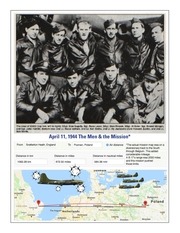
April 11, 1944 The Men & the Mission*
�
A TIME TO REMEMBER
11 April 1944
The day started at 5:00 A.M. when the duty clerks
made the rounds and woke up the crews scheduled
for a mission that day. I was the co-pilot of a B-17 in
the 339th Bomb Squadron, 96th Bomb Group, Third Air
Division, 8th Air Force, based at one of the multitude
of Air Bases which dotted the English countryside.
Our base was located at Snetterton Heath which was
a rail stop in the countryside of Suffolk County. We
were about thirty (30) miles from Bury Saint Edmunds
and approximately 100 miles N.N.E. of London.
Breakfast was great. As on all mission days, you
could have as many "fresh" eggs as you wanted, plus
bacon, ham or sausage (or all of these), and even
steak and potatoes if you so desired. Days when you
weren't scheduled for a Mission it was dried eggs,
et cetera.
Breakfast over, we went to the Briefing Room, a fairly
large room with the whole of one end taken up with a
huge map of Europe, including England. This map was
covered with a curtain and it was a very dramatic moment when the Briefing Officer drew back the curtain
and revealed what was to be the "Target for Today".
Today's "target” was Poznan, Poland, about one
hundred and sixty (160) miles due east of Big 'B"- Ber
- lin. The lines drawn in grease pencil on the
Plexiglas cover of the map elicited a lot of "Oh my
God, how damn far is that?" and "Hell, we'll never
make it back" comments from the crews. After a few "
at ease" calls from the C.O., we were given the gist of
what the long lines meant. Instead of flying over the
North Sea (Denmark and the Baltic Sea), and being
subjected to very little anti-craft fire and fighter
attacks, we were routed over land, across the
northern most tip of France, Belgium and the long
haul across Germany, past Berlin and on to Poznan.
This was an attempt at diversion; to make them think
we were going to some other target.
With a lot of cloud under us most of the way and
clearing up slightly when we reached Poznan, weather was to be our ally. If it were undercast at Poznan
and our Pathfinder (Radar) Aircraft couldn't make out
the primary target we were to fly to our secondary
target Stettin, Poland, on the Oder River about forty
(40) miles inland from the Baltic Sea. I'm not sure
how many groups were in the force assigned to bomb
Poznan, but our plan was to be part of a composite
group, made up of planes from several different
Squadrons and Groups within the Third Air Division.
(A note of explanation: a Squadron consisted of four
flights of three planes each, with spare crews and
planes; a Group was made up of three Squadrons and
so on up the chain of command thru Wing, Division
and numbered Air Force). The route we were to fly
and the other factors controlling the mission, assembly, climb to altitude, rendezvous with other groups,
air speed, et cetera, gave us an estimated time in
flight from take off to landing at home base, of just
under twelve (12) hours.
This was stretching it just a bit, and asking allowance for a very small fuel reserve. We (the whole
Poznan bomber force) were forced to maintain a
slower than normal air speed to conserve fuel. This
meant that any time we were over anti-aircraft batteries they would have a longer period of time to zero
in on us, and it also meant that many of the fighter
planes which came up and attacked us on our way
to Poznan had ample time to return to their bases,
refuel, rearm and then come back up and press their
sustained attacks again on our way home from the
target.
We only knew one other crew in the Composite
Group, Lt. John W. Ziegler and his co-pilot Joe Gold
and the rest of their crew.
On the first leg of the flight we ran into a few scattered areas where there was concentrated flak. But
our main concern was the incessant fighter attacks
which dove right thru the B-17 formation and it appeared that some of them were committed to crashing a B-17 to take it down.(SEE FOOTNOTE 1.) This
caused several of the pilots to take drastic evasive
action. Three of our 17's were shot down, and the
one flying my left wing got a direct hit in the Bomb
Bay and just disintegrated. We didn't have time to
worry about it or anything, but that was the slot John
Ziegler had been flying.
Over Poznan the Pathfinders could not pick up the
targets so we were routed to Stettin. On the way to
our secondary target we had more vicious fighter
attacks, and the closer we got to Stettin, the heavier
the flak. We lost one engine (No.3) over the target,
and shortly after "Bombs Away" and before we had
the Bomb Bay doors all the way closed, we got a
near miss just below the plane, which sprung the
doors and did some minor structural damage so the
�
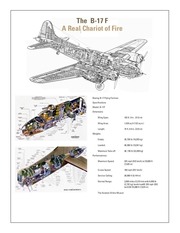
The B-17 F
A Real Chariot of Fire
Boeing B-17 Flying Fortress
Specifications
Model: B-17F
Dimensons
Wing Span:
103 ft. 9 in. (31.6 m)
Wing Area:
1,420 sq ft (132 sq m )
Length:
74 ft. 8.9 in. (22.8 m)
Weights:
Empty:
35,728 lb (16,205 kg)
Loaded:
40,260 lb (18,261 kg)
Maximum Take-off:
48, 728 lb (22,099 kg)
Performamnce:
Maximum Speed:
325 mph (523 km/h) at 25,000 ft
(7,625 m)
Cruise Speed:
160 mph (257 km/h)
Service Ceiling:
30,000 ft (9,144 m)
Normal Range:
2,000 miles (3,219 km) with 6,000 lb
(2,722 kg) bomb load@ 220 mph (352
km/h)@ 25,000 ft (7,625 m)
The Aviation Online Musum
�
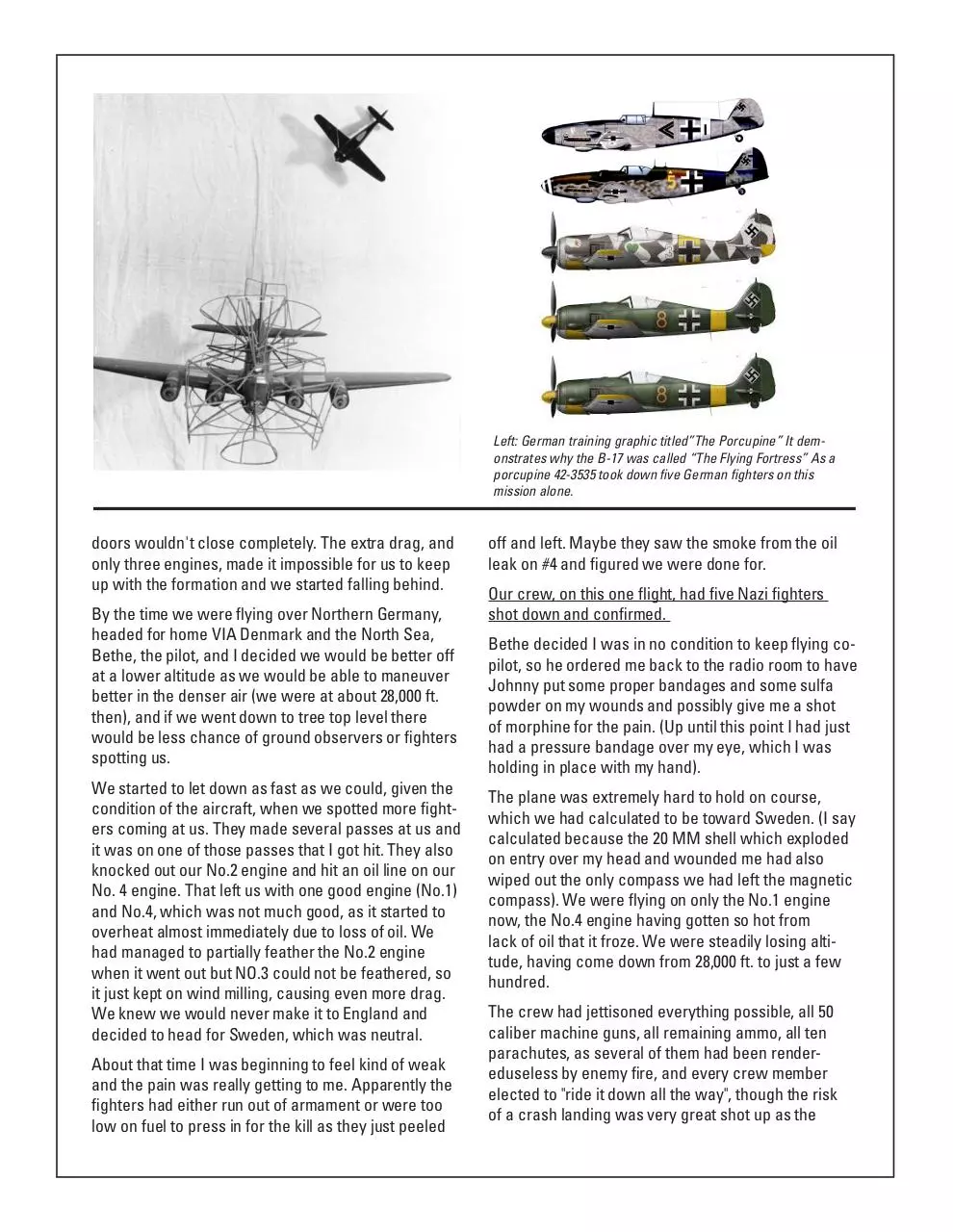
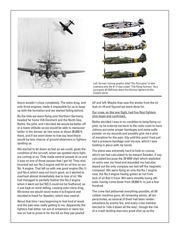
Left: German training graphic titled”The Porcupine” It demonstrates why the B-17 was called “The Flying Fortress” As a
porcupine 42-3535 took down five German fighters on this
mission alone.
doors wouldn't close completely. The extra drag, and
only three engines, made it impossible for us to keep
up with the formation and we started falling behind.
By the time we were flying over Northern Germany,
headed for home VIA Denmark and the North Sea,
Bethe, the pilot, and I decided we would be better off
at a lower altitude as we would be able to maneuver
better in the denser air (we were at about 28,000 ft.
then), and if we went down to tree top level there
would be less chance of ground observers or fighters
spotting us.
We started to let down as fast as we could, given the
condition of the aircraft, when we spotted more fighters coming at us. They made several passes at us and
it was on one of those passes that I got hit. They also
knocked out our No.2 engine and hit an oil line on our
No. 4 engine. That left us with one good engine (No.1)
and No.4, which was not much good, as it started to
overheat almost immediately due to loss of oil. We
had managed to partially feather the No.2 engine
when it went out but NO.3 could not be feathered, so
it just kept on wind milling, causing even more drag.
We knew we would never make it to England and
decided to head for Sweden, which was neutral.
About that time I was beginning to feel kind of weak
and the pain was really getting to me. Apparently the
fighters had either run out of armament or were too
low on fuel to press in for the kill as they just peeled
off and left. Maybe they saw the smoke from the oil
leak on #4 and figured we were done for.
Our crew, on this one flight, had five Nazi fighters
shot down and confirmed.
Bethe decided I was in no condition to keep flying copilot, so he ordered me back to the radio room to have
Johnny put some proper bandages and some sulfa
powder on my wounds and possibly give me a shot
of morphine for the pain. (Up until this point I had just
had a pressure bandage over my eye, which I was
holding in place with my hand).
The plane was extremely hard to hold on course,
which we had calculated to be toward Sweden. (I say
calculated because the 20 MM shell which exploded
on entry over my head and wounded me had also
wiped out the only compass we had left the magnetic
compass). We were flying on only the No.1 engine
now, the No.4 engine having gotten so hot from
lack of oil that it froze. We were steadily losing altitude, having come down from 28,000 ft. to just a few
hundred.
The crew had jettisoned everything possible, all 50
caliber machine guns, all remaining ammo, all ten
parachutes, as several of them had been rendereduseless by enemy fire, and every crew member
elected to "ride it down all the way", though the risk
of a crash landing was very great shot up as the
�
“Over Poznan the Pathfinders could not pick up the targets so we were routed to Stettin (Sczczecin).
on the way to our secondary target, we had more vicious fighter attacks.”
‘We lost one engine (No. 3) over target (Stettin). Over Northern Germany—They also knocked out our
No. 2 engine. . . . Over the North Sea—We were flying on only the No. 1 engine now. The No. 4 engine
having gotten so hot from the lack of oil it froze.”
Oops! Plan B
Oops! Plan C
“We knew we would never make it to England and decided to head for Sweden which was neutral.”
�
SNAFU
Note the official record lists ROSTOCK as the mission target and 3535 as “missing.”
Wartime censorship.
xx x
The B–17 brought the crew to the crash site flying on only one engine. (No. 1.)
The crew braces for a rough landing in Denmark
�
Crash Site Details
11 miles to Copehagen/26 miles from
Copenhagen to Sweden
The top right map (from the Danish Resistence) has
these captions (Translated from Danish.):
1. The plane crashed here
2 Some young people were here planting beets on
Bukkemose.
3. The pilots (crew) hid here in a small piece of wood
that still exists.
* The crew got in touch with the man on the Myrekær
farm who helped them on.
�
plane was. Anything that wasn't fastened down got
thrown out, and I can still see our Bombardier, Smitty,
scrambling around on his hands and knees in the
nose picking up waxed paper discs about 3 inches
in diameter (used in the sextant) and throwing them
out. We didn't know until after we had landed that he
had left the ammo belts for his nose turret in and had
800 rounds (400 each) left when we crashed. Could
have killed him at the time, but it hadn't made much
difference. When I went back to the radio room I had
to go thru the Bomb Bay on the catwalk and I could
see what the near miss had done to the Bomb Bay
doors. They were very nearly closed except in the
front, which were sprung open about three or four
inches. I lay down on the floor in the radio room and
Johnny (an ex-medic who had volunteered for gunnery school) took charge. His main duty was waist
gunner, but we had not been bothered by any fighters
for some time and the guns had been jettisoned, so he
could tend to me. He cleaned out the wound as best
he could with cold water from a canteen and poured
sulfa powder in and all around the wound. Then he
bandaged it and tried to give me a shot of morphine
for the pain. There were at least six first-aid kits per
plane and each had a small tube (with needle attached) of morphine. Johnny tried the first two kits
and had no luck; one tube had leaked and had no
morphine, while the other one wouldn't work when
the needle broke off at the tube as he tried to open
it. He quickly gathered all the other first-aid kits and
tried again. One more had a broken needle and another had leaked dry. Two kits had no tubes of morphine
in them (probably stolen), so I didn't get a shot. I'm
glad that they weren't all that reliable, because had
he been able to give me the shot, I would have been
out cold when We crash landed, and being unable to
run with the rest of the crew, would probably have
spent the rest of the war in a POW camp.
Tony Segalla, our Engineer and top turret gunner got
into the co-pilot's seat as soon as I went back to the
radio room. He had to help Bethe hold the plane on
course by pushing on the left rudder pedal as hard as
he could with both feet as the No.1 engine was the
only one still going and both No.3 and No.4 engines
were creating so much drag by wind milling. The
pressure to try and turn to the right was very difficult
to overcome.
From where I was sitting on the floor of the radio
room I could look out of the waist windows and by
rising up a little I could see that we were very, very
EYEWITNESS Report on to Canadian Air
Force Emergency Landing at Tåstrup
On April 11, 1944, an Allied bomb machine, a so-called
flying fortress on a land in Tåstrup, belonged to Knud
Larsen, who was his father. We lived at “Bækkemose” in Varpelev, and
our land was bound to the land in Tåstrup. After hearing and seeing various reports about the emergency landing and the rescue of the pilots, I
will tell you about the event on that day as I remember it.
My husband Edvard Thomsen from Ramsing and my brother Kåre Jensen,
“Eskelund” in Holtug and saw myself being able to plant berries for
seeds. We were heading out into the field after dinner with a bucket of
horses on the way between Varpelev and Tåstrup when a flying fortress
floated straight across our heads on us toward the East, turning right
to the front of two neighboring houses “Søndergård” and “Pilgrimage”
where it was so far down that it tore the telephone wires over, continued
just behind the house below the pond in the shingle between Varpelev
and Tåstrup, and was then laid down on the ground just after the road to
Tåstrup within the grave force to our field.
At the same moment the machine was stationary, the crew rushed out
of the machine and away, apparently to avoid a potentially explosive
hazard. When we had horses, I had to take care of them, while Kåre and
Edvard ran down to the airplaneand were the first to get in touch with
the aircraft. Neither Edvard nor Kåre were special linguists at the time.
However, they could understand so much that the airplanes asked what
direction Sweden was in, and of course they knew that, and they immediately proceeded in the direction they were given up.
At the same time, Johan Nissen was “Myrekær”, a team of harve. Here
the pilots took him. Johan, a language expert, asked them what they were
thinking and were told they would try to come to Sweden. Johan told
them that they had no chance in that way, but if they wanted to hide in a
small orchard plant that was on the neighbor’s land, he would see what
he could do.
The entire crew reached Sweden via Copenhagen and later arrived in
Canada
picked out of a report written by Asger Jensen, Bækkemose.
low. About that time Bethe called over the intercom to
brace ourselves, we were going to touch down.
Ten, maybe only five seconds before we touched
down I felt a shudder go thru the plane and thought
for sure it was going to break up. We all must have
been doing something right though, as the shudder
was the result of striking a telephone pole about
six or eight feet in from the wing tip, which slewed
the plane around enough to prevent it from crashing through a farm house which had been directly
in our path. At that low an altitude and that slow a
speed there was no way Bethe and Tony together
could have turned the aircraft without dropping a
wing and cart wheeling, instead of landing level,
straight ahead. Bethe did a superb job of landing that
plane - a lesser pilot could have killed us all. When
we touched down the weakened plane opened up
just ahead of the radio room and acted like a plow.
Dirt was forced up into the radio room so much that it
lifted us, Johnny, AI Esler and me, about three feet. All
�
we had to do to get out was take one step up through
the open hatch and jump onto the wing and down to
the ground.
I will never know where they all came from, but within
minutes after the plane came to rest there must
have been at least six or eight people there, all trying
to talk at once, and all trying to tell us what to do.
We couldn't understand the language and as more
people showed up, a man who identified himself as
a Canadian, who was working with the underground,
came and told us what we should do.
We were to cross a ditch between the field we had
landed in and the one next to it, which had been
plowed. Then we were to run about 300 yards to a
small stand of trees, which were back across the
ditch. We ran, I mean RAN as we were told, and
as we went down the plowed field, Johann Nessin
came behind us with a harrow and wiped out our
tracks. The trees were very dense and with so much
undergrowth that we had to crawl in on our hands
and knees. When we got to the center of the woods,
at least as close to the center as we could judge, we
just lay down and stayed quiet. This little stand of
trees and underbrush could not have been more than
a couple of hundred feet in diameter.
There were a few spots in the middle where some of
the crew could sit up, but most had to lie down. Mr.
Nessin came past with his harrow and told us to stay
quiet as they could hear the Nazis coming. He gave
us a password, which I wish I could remember but
can't, and said he would be back after dark when the
Germans were gone and tell us what their (the underground) plans were for us. Very shortly we heard the
Nazis over by the plane questioning the Danes. We
couldn't understand them but were sure they were
trying to find out what happened to us. We found out
later that the Danes told them we were gone when
they got there. They even told them they had heard
another plane and maybe it had picked us up.
It wasn't very long before the Nazis, who were all
older non-combat types of the occupation army, were
at the edges of the woods, looking for some clue as
to whether or not we were in there. About this time,
Smitty, the Bombardier got out his pocket knife and
started to cut a small branch off the tree he was lying
under, as it was brushing his face. The whole damn
tree was shaking, no noise, just movement, but if all
the Nazis hadn't been probing around the edges they
would surely have seen it waving. Tony reached over
and grabbed Smitty's wrist to make him stop. He really got the point across, because Smitty complained
of a sore wrist for days. Looking back on it, none of
us were surprised that Smitty would do such a stupid
thing; after all, hadn't he been throwing out paper
discs to lighten the aircraft and then left 400 rounds in
each of his nose guns?
The Nazis finally tired of poking around the edges and
left. I don't blame them for not entering the woods. I
don't think I would have if there was a possibility of
there being ten armed men in there. We stayed as
still and quiet as possible until dark when it was safe
to move around a little. It was getting colder with
darkness, and lying on the ground wasn't helping
any. I thought I would freeze. I started shivering and
Stan Mrozek and Hy Juskowitz crawled over and lay
as close to me as they could to warm me up. They
thought I was going into shock, but I wasn't. I was
just cold (I think).
We took off all of our insignia and all identification except our dog tags and buried it. (It may still be there).
It seemed like an eternity and we were beginning
to speculate as to what could have happened that
would stop the Danes from coming back. Nessin and
two other men came to us about midnight and led us
to his farm where we went up into a hayloft. It was
a welcome change – hay to lie on and a lot warmer
than the cold ground. Soon we were brought something to eat and drink, and though I can't remember
what it was, I do remember thinking it was the best
food I had ever eaten.
It had only been about 24 hours since breakfast the
day before, but what a long 24 hours.
They told us they were sure the Nazis would be
conducting a building by building search of the area
in the morning, so we would have to be moved before
daylight. Plans had been made to move us in a truck,
piled with straw, but as yet they didn't know where.
They told us to try and rest for a few hours and they
would be back for us before dawn. We were all far
too nervous and scared to sleep, especially our navigator, Hy. His full name was Hyman J. Juskowitz and
the fact that he was Jewish caused him great concern, as it was well known how the Nazis treated the
Jews. We still had our side arms and Hy vowed they
would not capture him alive.
In a short while that seemed endless to us we heard
a truck stop in front of the barn and Mr. Nessin called
�
for us to come down, and hurry. We all went out by
the truck and were told then that we would be taken
to Copenhagen. We were to be staying in an apartment on the top floor of the apartment building which,
I think, was ten or twelve stories high. We climbed
into the back of the truck and were covered with
straw.
I don't know how far we were from Copenhagen, but
it couldn't have been far as it seemed to be a short
trip under the straw. The truck stopped several times
and each time I thought it was Nazi patrols wanting to
search, but it must have been only stop signs as we
JULY 24, 1944, Robert “Tom” Jensen was killed by the
Gestapo, exactly 100 days after hiding the Bethe Crew, (FF8
of the 96th BG, 339th BS) in his apartment in Copenhagen,
Denmark for three days and then coordinating their escape
to Sweden.
immediately started again each time. Finally the truck
stopped and we heard the door open and the driver
(I never did know his name), told us to get down from
the truck, one at a time.
The truck was parked on the side of the street next
to an alley and they guided us, one by one, into an
elevator which was being held on the basement level.
When we were all in the elevator they took us to the
top floor and went into the apartment of one Tom
Robert Jensen and his wife. He was very active in the
underground and was later caught by the Gestapo
and killed. I don't remember for sure whether we
stayed in the apartment for two, three or four days,
but I do remember we were treated like royalty. We
had to be very quiet, walk around in our stocking
feet, talk in whispers and only go to the toilet before
they left in the morning or after they came home in
the evening. Neighbors might wonder who was in
the apartment and call the police. Food for a mob
like that was sure to be a problem, or so we thought.
They brought hot meals for us in the evening and we
had ample supplies of sandwiches and drinks during
the day. I don't know where they found it, but they
even brought us a small American flag on a stand
and American Cigarettes. We all crowded around the
radio in the evening and listened to the B B C (British Broadcasting Corp.) news of the war. We also
listened to the English broadcast of "Lord Haw Haw"
from Berlin Radio. Lord Haw Haw, (SEE FOOTNOTE
2.) as he was called, was British and had gone over
to the Nazi cause. He broadcast propaganda beamed
at Allied troops and obviously had quite a few spies
in England. To digress a bit, I recall one night several
weeks before being shot down when the crowd at the
Officer's Club was larger than usual, as the next day
was a "stand down" and no mission was scheduled. It
was time for the Berlin Radio and Lord Haw Haw, so
nearly everybody got quiet so we could hear. Well, he
gave his usual spiel about how well the Axis powers
were doing and how badly the Allies were doing and
what terrible losses the Air Force was sustaining. We
didn't believe it all but it did have a sobering effect.
Then something that left most of those present in
totaL disbelief. He said "A bit of advice for you chaps
of the 96th Bomb group. I know you don't have anything on for tomorrow, but if you want to be on time
for your next mission, the clock over the bar should
be reset. It is now, five minutes slow". All eyes went to
the clock, then, wrist watches and back to the clock.
Sure as hell, it was five minutes slow. How much else
did they know?
Scary.
As I have said, I am not sure how long we stayed
in the apartment in Copenhagen. You could figure it
out from the date on the Visa from Sweden which is
in my scrap book, as that date was the day after we
left Copenhagen. On the evening we were to leave
Copenhagen, they told us we should be ready on a
moment's notice, as they were not positive about
�
THE ESCAPE
A Miss is As Good as a Mile
“The plane was etremely hard to hold on course, which we had
calculated to be Sweden. (I say calculated because the 20 mm
shell which had exploded on entry over my head snd wounded me
had also wiped out the only the compass we had left, the magnetic
compass.)”
A glance at the map below shows how accurate their calculations
had been. The crash site was less than fifty miles from Sweden.
Yet it was deep in Nazi territory.
�
exactly what time the truck would be there to pick
us up. Nazi patrols had a habit of arbitrarily stopping any truck to inspect the cargo and its driver's
papers, so we had to expect that this might happen.
It didn't, and when the truck arrived sometime after
dark we all went down in the elevator to the same
building entrance we had used before. We were sent
out to the truck one at a time and each of us was put
in what must have been tanks for carrying fish. They
were about 2 1/2 feet wide. 3 1/2 feet deep and 3 1/2
feet long. They were made of fairly heavy gage steel
and each one had a cover. There was no fish odor
but! couldn't think of anything else they could have
been used for and when we arrived at our next stop
on "The Underground Railroad", it more or less confirmed our suspicions; it was a small fishing village on
the coast of Denmark, across from Sweden. We were
taken to an inn of some sort where they once more
fed us. They also had a Doctor there who checked my
wound, cleaned it up again and put on new bandages.
The Doctor had the highest praise for the job Johnny
had done cleaning, treating and bandaging me up.
He (the Doctor) did not speak English, and I had the
devil of a time convincing him that I had had a tetanus
shot not more than six weeks ago and didn't need one
now.
We sat around waiting for the rest of the night until
just before dawn. We were to be put on board a
fishing boat which was to rendezvous with another
fishing boat from Sweden. Finally it was time to leave
and we were all taken outside, down a short street
and told to crouch down behind a kind of sea wall
about three feet high. "Don't make a sound." We heard
footsteps and peering over the wall could see, a few
feet away, a Nazi soldier walking on patrol. He went
a short way past our position did an about face and
marched back the way he had cone. When he was
out of sight two of us at a time went over the wall
and ran to the boat where we were put into the small
cabin. Each time the patrol marched to the other end
of his beat two more of our crew made it to the boat.
Five times, and each time the tension was so high as
to be almost unbearable. It must have been far worse
for those poor Danes than it was for us, for if they had
been caught they would have been shot whereas we
would only have been taken prisoner.
Almost immediately, the "crew" of the boat came
down the street talking and laughing as if this was
just another fishing day. They walked over to the boat,
and even stopped on the way to give the patrol a light.
It seems he had run out of matches very soon after
going on duty. The boat crew came aboard and without any fanfare set out for the rendezvous. This was a
very ticklish operation as Denmark was an occupied
country and Sweden was neutral, and the territorial
waters of each country met in a well-defined line between the two. German patrol boats were operating
in the area and would fire on any Danish boat going
into Swedish waters or stop and search any Swedish
boat in Danish waters, but the rigid discipline of the
Nazi armed forces worked in our favor. Their patrols
were so regular you could set your watch by them,
and the Danes and Swedes had the rendezvous timed
to coincide with a period of time when there would be
no patrols in thearea. They shoved off the dock and
we were on our way to Sweden and safety.
It seemed an eternity before they cut the engine
back to idle, and we thought we must be close to the
Swedish boat but it was a patrol boat checking out
our boat. They just wanted to know what boat it was
and make sure it was authorized to be out.
The skipper of our boat knew and was known by all
the patrol boat crews so they didn't bother to come
aboard, or even get very close. We were all glad they
didn't or we were all set to go over the side and hold
onto a handrail that had been added to the side of the
boat just below the water line. It was not yet quite full
daylight, and the skipper told us later that had it been
light the patrol probably would not have questioned
them at all.
We started moving again and before long we were
out of sight of the patrol boat. We changed course
and before very long we spotted the Swedish boat,
apparently just sitting waiting for us. The skipper
pulled alongside and we were told to GO. As fast as
we could we jumped into the Swedish boat and hid
below the rail. In a matter of seconds the two boats
separated and we were in Swedish territorial waters
and safe.
I don't remember how long it took us to get to Malmo,
but that made no difference, we were safe. As soon
as we landed we were met by the American Consulate, who arranged for the Swedish Visas for each of
us. Almost immediately they took me to the hospital
to check out how serious my eye wound was, Bethe
and the rest of the crew were taken to temporary
quarters, as they were to go to Stockholm the next
day. When I got to the hospital they cleaned me up
and I was admitted. The Chief of Surgery told me (thru
�
One More Gauntlet to Run
Sweden to Scotland
“The plane we were to be going on was a B-24 Bomber which had
been modified to carry people insted of bombs . . . Our crew was not
the only passengers, as there were a lot of Jewish refugees who had
made their way thru Denmark to Sweden, and there were quite a few
Norwegians . . .
“When we were airborne, we immediately started climbing, as we
had to clear the mountains in Norway. We also had to take a longer
than”as the crow flies” route to avoid anti-aircraft guns and the
fighters based in Norway.”
�
an interpreter) that they would have to operate on
my eye to remove shell fragments in the eyeball and
to repair the damage done to my eyelids. Also, some
stitches had to be taken in a small laceration in my
right cheek just below the eye.
(This was where a shell fragment had entered and
gone down thru the roof of my mouth and broke my
upper plate, which they also fixed). Bethe and the
rest of the crew came by to tell me they were leaving
for Stockholm around noon and told me where they
would be staying. They didn't know and, because
of security, couldn't find out when there would be a
flight to England, so they didn't know whether or not
I would get out of the hospital in time to catch up
with them.
They operated on my eye the next day and that was a
weird experience. The doctor used a local anesthetic
and I could see everything he did. It was kind of scary
lying there and watching the instruments get closer
and closer, but there was no pain at all and all I could
feel was a slight pressure as he took the pieces of 20
MM out of my eyeball and sewed up my eyelid and
cheek. It didn't take very long and I was pleasantly
surprised that there was relatively little pain as the
anesthetic wore oft just a slight discomfort. The doctor that did the surgery told me there was very little
damage to the eyeball and if there was any change
in my vision it would be almost unnoticeable. He also
told me that the first-aid (Johnny's cleaning, sulfa
powder and bandaging) had in all probability saved
the eye from infection and possible loss of the eye.
Thanks again, Johnny. The doctor told me he didn't
think there would be any complications but was going
to keep me for a couple of days to make sure. He was
great. He came to visit me several times a day and we
had some interesting talks.
He told me there were only a few of the staff at the
hospital who spoke English and he enjoyed talking to
an American. I told him it was a mutual feeling, as it
was difficult to communicate with the nurses in sign
language. He also told me a bit about Sweden and the
socialized society. For instance, the Chief Surgeon at
the hospital was not earning as much as I was as a
2nd Lieutenant. Taxes were very high also but their
standard of living was also very high. He seemed to
have few complaints about the system.
I don't remember how many days I was in the hospital at Malmo. On the day I was released Lt. King
from the Air Attaché's office picked me up and took
me to the train for my trip to Stockholm. Some train.
I went first-class coach and it was really first-class;
huge windows and a swivel recliner at each window.
There was a diner car on the train, and the waiters all
spoke English, as well as French and German and, of
course, Swedish. One of them told me, when I asked,
that most people in any way employed in the tourist
endeavors; transportation, lodging, restaurants, etc.
spoke several languages.
It was about 300 to 350 miles from Malmo to Stockholm and we made very good time. It seemed to me
that the train was going very fast, though it was one
of the smoothest train rides I had ever had. Bethe and
the rest of the crew met me at the station and took me
back to the hotel where they were staying; the
Continental. It was a very nice hotel and I really enjoyed the three or four days I spent there.
Only one mishap, which I probably shouldn't mention.
The first time I went into the bathroom I made the
mistake of using the bidet instead of the commode
and got the surprise of my life when I "flushed" it.
They took me shopping for clothes the next day,
which the Air Force paid for, and I got everything from
skin out; underwear, socks, two shirts, shoes, necktie,
suit and a topcoat. I also got shaving gear, including
a mug and brush. The clothes I turned over to the Air
Force when I got back to our base but I still have
the shaving brush, which is pure badger bristle and
cost $9.00 even then. I don't know why it was so
expensive.
It was just luck, fate or something that the rest of
the crew was still in Stockholm. They had left on a
flight for Scotland the day before I got there, but foul
weather and unexpected head winds over the North
Sea forced the plane to turn back. The flight was
rescheduled and we were taken out to the airport
late in the afternoon. The plane we were to be going
in was a B-24 Bomber, which had been modified to
carry people instead of bombs. A platform had been
built in the Bomb Bay with four benches the length of
the bay; one on each side and two back to back
in the middle. The Bomb Bay doors on the B-24
opened by rolling up along the inside of the fuselage
(like a roll top desk) and we got in thru a trap door in
the platform.
Our crew was not the only passengers, as there
were a lot of Jewish refugees who had made their
way thru Denmark to Sweden, and also quite a few
�
Norwegians. Norway was occupied by the Nazis and
for some reason they were far more lenient with the
Danes than the Norwegians.
We took off just before dark, and there were so many
passengers in the plane that a few of them had to
move to the nose of the plane so it could keep the
nose wheel on the ground to taxi to take-off position.
By holding the brakes on and using about half throttle
the pilot could hold the nose down while the passengers could make their way back to the rear of the
plane.
When we were airborne we immediately started
climbing, as we had to get high enough to clear the
mountains in Norway. We also had to take a longer
than "as the crow flies" rout to avoid anti-aircraft guns
and the fighters based in Norway. It was cold – there
was no heat in the Bomb Bay and a frail old man from
Norway (he told us he was 78) was in a very bad way.
Several of us gave him some of our extra clothes but
he couldn't seem to get warm at all. His fingernails
started to turn blue and we were afraid he was going
to die. Again Bethe proved his worth – he figured that
the plane crew would have hot coffee so he crawled
up to the pilot's compartment, told them of the old
man's predicament, and came back with a thermos
full of hot coffee. We gave some to the poor fellow
and in a matter of minutes he was O.K. He stopped
shaking and the color in his hands came back. The
rest of the coffee was given to several other people
who seemed to be in the greatest need for it. After we
landed, the pilot told us that he would personally see
to it that any future flights would have the hot coffee
available. He couldn't promise cream and sugar, as
they were rationed, but the important thing was the
hot drink. I think it saved the old man's life.
We landed at a field in Scotland and our crew were
the first ones out of the plane. I stood beside the
plane and counted them as they came out, and there
were 78 passengers and a crew of four, including our
crew of ten. That made 82 people on that B-24. I still
find it hard to believe.
We were taken in hand by boys of G-2 (Intelligence it was still the Army Air Corps then) and delivered to
63 Brook Street London for "de-briefing". We figured
it wouldn't take long and were anxious to get out and
explore London. What a surprise we were in for. We
were restricted to the premises "until further notice"
and informed chat the de-briefing would start in the
mourning. It lasted for several days; they interrogated
us individually, in two's and three's and then as a
complete crew. We were rather unique, being one of
the very few crews who escaped from enemy territory as a complete crew during the war. They wanted
to know about everything, and I mean everything we
saw or heard while in Denmark. One thing that made
us feel that we had a pretty good intelligence force
was this; when we told them about the crash landing,
and the Canadian who was there with the Danes, they
said "Oh yes, that would be "so and so" naming him. I
can't remember his name now, but we knew it then.
After the first few days our restriction was lifted and
we were given passes to go out on the town –
London. The whole crew went together and were
seeing the sights when one of the crew (I don't remember which one) let out a yell. "It can't be." Almost
simultaneously we heard a yell from up the street.
We all turned to look and all hell broke loose. It was
John Ziegler's crew – every last one of them, safe
and sound. We were so sure that theirs had been the
plane on my left wing which got the direct hit and
exploded. What happened was that in some of the
violent maneuvering to avoid the German fighters,
several planes in the group had rejoined formation in
different positions. Joe's Crew saw us drop behind,
and when we didn't make it home, they were sure we
were either dead or captured. Needless to say, we
were twenty happy guys and had quite a celebration
that night.
After a few sight seeing tours we were sent back to
our base to get our personal belongings before being
returned to the States. As escapees or evaidees we
were placed in what was called category "R", which
meant we were restricted from any more combat
flying. Having been in enemy territory, if we were
shot down and captured we could have been shot as
spies. Good news – we all wanted to go home. Lady
luck had sailed on us so many times in the past, little
while and nobody can have good luck forever.
We chose to fly a war-weary B-1 7 back to the States
for modification and our first stop was Prestwick,
Scotland, where we were to pick up the B-17 and
took off for Reykjavik, Iceland, which was the only
stop we would make before landing at La Guardia in
New York.
The ground crew asked us if we had any scotch (I
guess every war-weary crew that came through
had the same idea) and told us we would have all
our baggage checked by customs when we landed
�
and would have to pay duty on each bottle. They also told us that the plane would be parked in a special area
reserved for the Air Corps.
Well, before we took off from Reykjavik, we hid bottles of scotch all over that plane. The majority of it was
wrapped in our wool socks and placed in between the braces of the partially lowered flaps. Then the flaps were
raised completely and we were ready to go. Not being able to lower the flaps 30 degrees (which was standard
take-off procedure) we held the brakes until we had almost full power on and the plane just kind of leaped down
the runway. No problem. We were airborne with a third of the runway left.
We had an uneventful flight to La Guardia, all be it peppered with smart remarks about being sure to make a
"no-flap" landing or that would be the first time in history it had ever rained scotch on New York. All went well
on the "no flap" landing, and after checking in thru customs, we went back down the field to the Air Corps area
and retrieved our scotch. We were all sent to a processing center (to be given new assignments stateside, said
lengthy and emotional good-byes to each other, and were truly on our way home.
Raoul A. de Mars, Lieutenant Colonel
Pilot:
Kenneth Eugene Bethe, 2LT
1 May 1921-6 Jan 1980
Engineer TT:
Constantino Leo Segalla SSGT
6 Feb 1923-5 Jan 1962
Bethe Crew (FF8) 339th BS
Co-Pilot:
Raoul A. De Mars 2LT
20 Sep 1918-18 Jan 2004
Navigator:
Hyman Judah Juskowitz 2LT
1920-20 May 2015
Bombardier:
Robert Dale Smith 2LT
15 Sep 1921-18 Mar 2015
Asst Engineer RW:
Russell Adolph Lauer SGT
18 Mar 1922-5 Mar 1985
Asst Radio Operator BT:
Stanley Ted Mrozek
14 Nov 1922-March 1979
Radio Operator TT:
Albert Charles Esler SSGT
Dec 1910-16 Sep 1972
Armorer TG:
Everett E Morgan Jr SGT
8 Sep 1920-11 Dec 1964
Asst Armorer LW:
John Alvin Hamlin SGT
16 Aug 1920-3 Jan 2003
�
A Bird With Clipped Wings
Danish Underground Footage
Split in fuselage that acted as
a brake.
Civilians had free access
to the site.
➔
➔
Wing tip hit a
telephone pole
that kept it from
spinning around
➔
BELOW: The Germans strip the plane for
scrap. Note as the nose cone section is
worked over, the wings and engines have
already been separated.
Under the watchful eye of
a guard the local boys get
a peek.
Split in fuselage that acted as
a brake.
➔
“Bethe did a superb job of landing that
plane—a lesser pilot could have killed us all.
When we touched down the weakened plane
opened up just ahead of the radio room and
acted like a plow.”
�
42-3535 Graffiti
Fore and Aft
What was the nose art?
➔
Colonel ge Mars could only
remember that the mascots
might have been four monkeys
in parachutes. No research or
photo enlargements could reveal
what the original art was so it was
reproduced using imagination.
Aside from being the crew’s cheerleader, the
tail gummer considered himself a Don Juan.
�
FOOTNOTES
1.
Nazi Kamakazes?
Colonel deMars’ comment on possible suicide dives by German fighters
had merit. Individuals were known to ram the bombers and this possibly
inspired the fully organized attack of “Sonderkommando Elbe” one year
later over the same areas 42-3535 had flown in 1944. Could these have
been pracice runs by that group?
Towards the end of World War II, the German Luftwaffe airforce resorted
to a series of deadly suicide missions. Die Welt journalist and historian
Sven Felix Kellerhoff examines a little documented chapter in Germany’s
military history.
Sven Felix KellerhoffDIE WELT
https://www.worldcrunch.com/world-affairs/german-kamikazes-littleknown-wwii-tale-of-suicidal-pilots-over-europe
2011-03-29
English edition • WORLDCRUNCHThe attack came from above. On April 7,
1945, as more than 1,300 four-engine, U.S. Air Force bombers began their
approach over northern Germany, on a mission to target factories and
freight stations, they were suddenly challenged. At 1:35 in the afternoon,
German single-engine planes began to fall out of the sky from above
them. But instead of closing in from the usual distance of about 600
2.
meters, firing, and then turning away, the German planes set themselves
on a collision course.
The U.S. pilots of the B-17 and B-24 bombers were left with only seconds
to quickly maneuver their comparatively slower planes out of the way.
Nearly two dozen of the Flying Fortresses and Liberators did not succeed: they collided with the fighters. Various reports cite that between
eight and 15 U.S. planes were torn apart or so badly damaged that they
had to be abandoned. Another 28 bombers were shot down by German
fighters.
It was the only major attack undertaken by the “Sonderkommando
Elbe”, a special unit whose mission illustrated the total despair that had
befallen the Luftwaffe during the last months of the War. Ten days later,
the group launched another attack - this time the pilots dove into Soviet
troops crossing bridges over the Oder River east of Berlin. The full
details of these attacks are lost in rumors and myths. Similarly, legends
are told of a SS special unit with the same mission that was known
under the code name “Leonidas.” Whether this group actually existed or
whether it was a post-War invention still remains unclear.
What is known, however, is that the idea for the “self-sacrifice” missions using fighter aircraft came from the pilot and Hermann Goering
confidant Hajo Herrmann. He was also the inventor of “Wilde Sau,” the
technique that engaged British night bombers with single-seat fighter
planes. Day fighters were used during these attacks, and their rapid
surprise attacks were enabled by light grenades
that lit up the night sky. The initiative suffered
such great losses that it was given up after just
a few months.
Take the case of Heinrich Ehrler
Heinrich Ehrler (14 September 1917 – 4 April
1945) was a German Luftwaffe military aviator
during World War II, a fighter ace credited with
208 enemy aircraft shot down in over 400 combat missions. The majority of his victories were
claimed over the Eastern Front, with nine claims
over the Western Front which included eight in
the Messerschmitt Me 262 jet fighter.
On 4 April 1945, he shot down two Allied bombers for his final two victories, before destroying a third by ramming with his damaged aircraft
He immediately became a broadcaster for Joseph Goebbel’s Propaganda
Ministry. His radio program reached England weekly from 1939 to 1945.
On the night of April 30, 1945, a drunken Joyce made his last broadcast
from Hamburg as British troops entered the city. With his adopted world
crashing down around him, but still committed to the Nazi cause, Joyce
rambled on through his farewell speech. In Berlin, Hitler was simultaneously saying good-bye to his entourage in anticipation of ending his life a
few hours later.
Captured by the British, Joyce stood trial for treason. The court denied his
claim of American citizenship because he held a British passport. He was
found guilty and hanged on January 3, 1946
Lord Haw-Haw
http://www.eyewitnesstohistory.com/vohawhaw.htm
Lord Haw-Haw was the name British listeners gave to William Joyce,
a German radio propaganda broadcaster during World War II. Born in
Brooklyn, New York in 1906, Joyce moved with his English mother and
Irish-American father to England in 1921. He joined the Nazi movement in
England in the mid-’30s and fled to Germany just before war broke in 1939.
�
 Historical archive . public document