Lectures on Theory of Numbers
Md. Shah Noor
Associate Professor
Department of Mathematics
Shahjalal University of Science and Technology
Sylhet, Bangladesh
email: noorms100@gmail.com
web:http://www.sust.edu
�
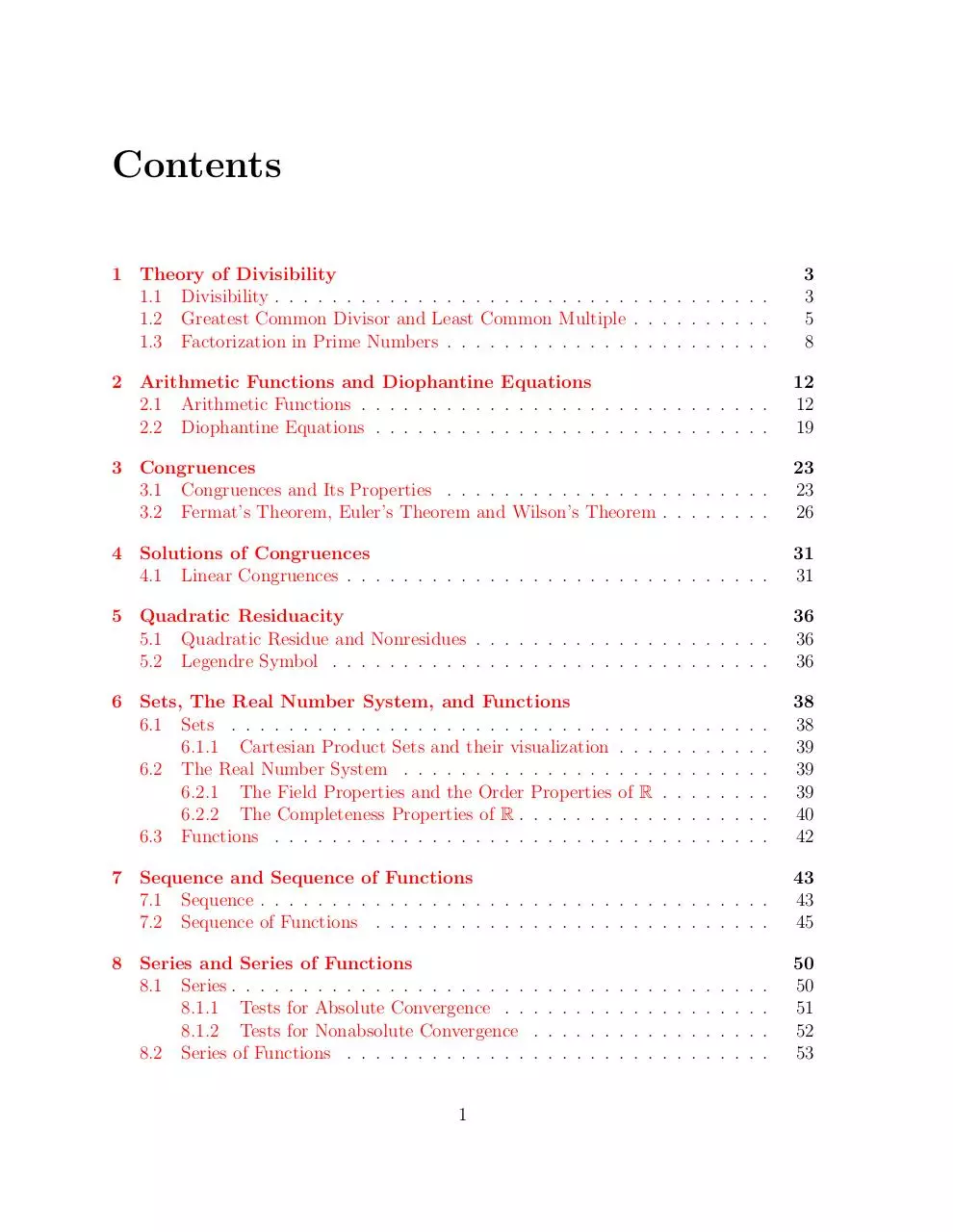
Contents
1 Theory of Divisibility
1.1 Divisibility . . . . . . . . . . . . . . . . . . . . . . . . . . . . . . . . . . .
1.2 Greatest Common Divisor and Least Common Multiple . . . . . . . . . .
1.3 Factorization in Prime Numbers . . . . . . . . . . . . . . . . . . . . . . .
3
3
5
8
2 Arithmetic Functions and Diophantine Equations
2.1 Arithmetic Functions . . . . . . . . . . . . . . . . . . . . . . . . . . . . .
2.2 Diophantine Equations . . . . . . . . . . . . . . . . . . . . . . . . . . . .
12
12
19
3 Congruences
3.1 Congruences and Its Properties . . . . . . . . . . . . . . . . . . . . . . .
3.2 Fermat’s Theorem, Euler’s Theorem and Wilson’s Theorem . . . . . . . .
23
23
26
4 Solutions of Congruences
4.1 Linear Congruences . . . . . . . . . . . . . . . . . . . . . . . . . . . . . .
31
31
5 Quadratic Residuacity
5.1 Quadratic Residue and Nonresidues . . . . . . . . . . . . . . . . . . . . .
5.2 Legendre Symbol . . . . . . . . . . . . . . . . . . . . . . . . . . . . . . .
36
36
36
6 Sets, The Real Number System, and Functions
6.1 Sets . . . . . . . . . . . . . . . . . . . . . . . . . . .
6.1.1 Cartesian Product Sets and their visualization
6.2 The Real Number System . . . . . . . . . . . . . . .
6.2.1 The Field Properties and the Order Properties
6.2.2 The Completeness Properties of R . . . . . . .
6.3 Functions . . . . . . . . . . . . . . . . . . . . . . . .
.
.
.
.
.
.
38
38
39
39
39
40
42
7 Sequence and Sequence of Functions
7.1 Sequence . . . . . . . . . . . . . . . . . . . . . . . . . . . . . . . . . . . .
7.2 Sequence of Functions . . . . . . . . . . . . . . . . . . . . . . . . . . . .
43
43
45
8 Series and Series of Functions
8.1 Series . . . . . . . . . . . . . . . . . . . . .
8.1.1 Tests for Absolute Convergence . .
8.1.2 Tests for Nonabsolute Convergence
8.2 Series of Functions . . . . . . . . . . . . .
50
50
51
52
53
1
.
.
.
.
.
.
.
.
.
.
.
.
.
.
.
.
.
.
.
.
.
.
.
.
. . .
. . .
. . .
of R
. . .
. . .
.
.
.
.
.
.
.
.
.
.
.
.
.
.
.
.
.
.
.
.
.
.
.
.
.
.
.
.
.
.
.
.
.
.
.
.
.
.
.
.
.
.
.
.
.
.
.
.
.
.
.
.
.
.
.
.
.
.
.
.
.
.
.
.
.
.
.
.
.
.
.
.
.
.
.
.
.
.
.
.
.
.
.
.
.
.
�
9 Limit and Continuity of a Function
9.1 Limit of a Function . . . . . . . . . . . . . . . . . . . . . . . . . . . . . .
9.2 Continuous Function . . . . . . . . . . . . . . . . . . . . . . . . . . . . .
55
55
56
10 Differentiation
60
11 Riemann Integration
63
A Reviews
65
2
�
Chapter 1
Theory of Divisibility
1.1
Divisibility
Definition 1.1.1 (Natural Number). A number used for counting is said to be a natural number. The set of natural numbers is denoted and defined by N = {1, 2, 3, 4, 5, · · · }.
Definition 1.1.2 (Integer). Any whole number positive, negative, or zero is said to be an
integer. The set of integers is denoted and defined by Z = {· · · , −3, −2, −1, 0, 1, 2, 3, · · · }.
Definition 1.1.3 (Divisibility). A number b is said to be divisible by a number a(a 6= 0)
if there is a number c such that b = ac. We denote this by a | b, read as a divides b. If
no such integer can be found we write a ∤ b, read as a does not divide b.
Example 1.1.1.
(1) 3 | 12 because 12 = 3 · 4
(2) 3 ∤ 7 because there is no integer c such that 7 = 3 · c.
If a | b, then a is called a divisor of b and b is called a multiple of a. If a | b and
0 < a < b, then a is called a proper divisor or factor of b. We have b = a · c = (−a) · (−c).
Thus if a | b, then −a | b. For practical purposes we can limit our attention to only
positive divisors of integers. 1 is a divisor of any integer and 0 is a multiple of any
integer. Any non-zero integer is a divisor or multiple of itself.
Definition 1.1.4 (even number and odd number). A number which is multiple of 2 is
called an even number, otherwise it is called an odd number.
Theorem 1.1.1. For any integer a, b, c the following hold:
(i) a | b ⇒ a | bc
(ii) a | b and b | c ⇒ a | c
(iii) a | b and b | a ⇒ a = ±b
(iv) a | 1 ⇒ a = ±1
3
�
(v) a | b and a | c ⇒ a | (bx + cy) for any integers x and y.
The sum, difference, and product of two integers are obviously integers but the quotient of two integers may or may not be an integer.
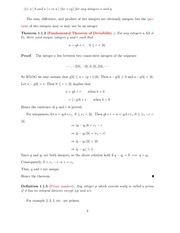
Theorem 1.1.2 (Fundamental Theorem of Divisibility ). For any integers a, b(b 6=
0), there exist unique integers q and r such that
a = qb + r,
Proof.
0 ≤ r < |b|.
The integer a lies between two consecutive integers of the sequence
· · · , −2|b|, −|b|, 0, |b|, 2|b|, · · ·
So WLOG we may assume that q|b| ≤ a < (q + 1)|b|. Then a − q|b| ≥ 0 and a − q|b| < |b|.
Let a − q|b| = r. Then 0 ≤ r < |b| implies that
a = qb + r
when b > 0
= (−q)b + r
when b < 0
Hence the existence of q and r is proved.
For uniqueness, let a = q1 b+ r1 , 0 ≤ r1 < |b|. Then qb+ r = a = q1 b+ r1 , 0 ≤ |r1 −r <
|b|.
⇒ (q − q1 )b = r1 − r
⇒ |q − q1 ||b| = |r1 − r|
⇒ |q − q1 ||b| < |b|
⇒ |q − q1 | < 1
Since q and q1 are both integers, so the above relation hold if q − q1 = 0 =⇒ q = q1 .
Consequently, 0 = r1 − r ⇒ r = r1 .
Thus, q and r are unique.
Hence the theorem.
Definition 1.1.5 (Prime number). Any integer p which exceeds unity is called a prime
if it has no integral divisors except ±p and ±1.
For example 2, 3, 5, etc. are primes.
4
�
Definition 1.1.6 (Composite number). An integer c > 1 which has divisors other than
±c and ±1 is called a composite number.
For example 6, 30, 45, etc. are composite numbers.
Note. 1 is neither prime nor composite.
1.2
Greatest Common Divisor and Least Common
Multiple
Definition 1.2.1 (Greatest Common Divisor(g.c.d. )). The greatest integer g that divides
both of two integers a and b is called the g.c.d. of a and b and is denoted by (a, b) = g.
For example (20, 30) = 10, (−6, 9) = 3. Note that (a, b) ≥ 1, (a, 0) = |a|, (0, 0) = ∞
and, (a, a) = a for any integer a 6= 0.
Definition 1.2.2 (Relatively prime). If (a, b) = 1 then the integers a and b are called
relatively prime or co-prime.
Theorem 1.2.1 ( Euclidean Algorithm(330-275 B.C.)). Let a and b be two positive integers where b ∤ a. Let r0 = a, r1 = b and apply the division algorithm repeatedly to obtain
a set of remainders r2 , r3 , · · · , rn , rn+1 defined successively by the relations:
r0 = q1 r1 + r2 , 0 < r2 < r1
r1 = q2 r2 + r3 , 0 < r3 < r2
r2 = q2 r3 + r4 , 0 < r4 < r3
···
···
···
···
···
rn−2 = qn−1 rn−1 + rn , 0 < rn < rn−1
rn−1 = qn rn + rn+1 , where rn+1 = 0.
Then rn , the last nonzero remainder in this process, is (a, b), the g.c.d. of a and b.
Proof.
Since r1 , r2 , · · · , rn+1 are decreasing and nonnegative, so there is a stage at
which rn+1 = 0. The last relation rn−1 = qn rn shows that rn | rn−1 and hence the
penultimate relation implies that rn | rn−2 . By induction we see that rn | ri , ∀i. In
particular, rn | r1 = b and rn | r0 = a, so rn is a common divisor of a and b.
Now let d be any common divisor of a and b. Then d | a = r0 and d | b = r1 . The
definition of r2 shows that d | r2 . The next relation shows that d | r3 . By induction,
d | ri , ∀i, so d | rn . This shows that rn = d.
Hence rn is the required g.c.d. of a and b.
5
�
The following theorem states that the g.c.d. of any two integers can be expressed as
an integral linear combination of them.
Theorem 1.2.2. If g = (a, b), then there exists integers x and y such that g = ax + by.
Proof.
Consider the linear combinations au + bv, where u, v ∈ Z. This set of integers
includes positive and negative values, and 0 by the choice of u = v = 0. Choose x and y
so that ax + by is the least positive integer l in the set. Thus ax + by = l.
Now we prove that l | a and l | b. Suppose that l ∤ a. Then there exist integers q and
r such that
a = ql + r, 0 < r < l.
⇒ r = a − ql = a − q(ax + by) = a(1 − qx) + b(−qy).
Thus r is in the set {au + bv}. This contradicts the fact that l is the least positive integer
in the set {ax + by}. Thus l | a. Similarly, we can show that l | b.
Now, since g is the g.c.d. of a and b, we may write a = gA, b = gB, and l = ax + by =
g(Ax + By). Thus, g | l and so we conclude that g ≤ l. Now g < l is impossible as g is
the g.c.d. of a and b. Thus, g = l = ax + by.
Corollary 1.2.3. (a, b) = 1 ⇐⇒ ∃ x, y ∈ Z such that ax + by = 1.
Example 1.2.1.
1. Find the g.c.d. of 1769 and 2378 using Euclidean algorithm
2. Hence express it as an integral linear combination of these numbers.
Solution: 1. We have:
2378 = 1 · 1769 + 609
1769 = 2 · 609 + 551
609 = 1 · 551 + 58
551 = 9 · 58 + 29
58 = 2 · 29
Hence by the Euclidean algorithm (1769, 2378) = 29.
2. Now
29 = 551 − 9 · 58
= 551 − 9 · (609 − 1 · 551)
= 10 · 551 − 9 · 609
= 10(1769 − 2 · 609) − 9 · 609
= 10 · 1769 − 29 · 609
= 10 · 1769 − 29 · (2378 − 1 · 1769)
= 39 · 1769 + (−29) · 2378
6
�
∴ 29 = 39 · 1769 + (−29) · 2378.
Definition 1.2.3 (Least Common Multiple). The least common multiple(l.c.m. ) of two
or more non zero integers is the smallest positive integer that is divisible by all of them.
If l is the l.c.m. of a and b, we denote it by [a, b] = l.
For example [20, 30] = 60. Note that there is no greatest common multiple of two or
more integers. Also observe that g.c.d. and l.c.m. are unique.
Theorem 1.2.4. If ab > 0, then [a, b](a, b) = ab.
Proof.
Let [a, b] = l and (a, b) = g. Then a | l and b | l gives ab | la and ab | lb
∴ ab | (la, lb)
⇒ ab | l(a, b)
⇒ ab | lg
On the other hand, since a |
l|
ab
g
⇒ lg | ab
ab
g
and b |
ab
,
g
so
ab
g
· · · (1)
is a common multiple of a and b. Therefore,
· · · (2) From (1) and (2) we conclude that lg = ab ⇒ [a, b](a, b) = ab.
�
�
Note. [a, b]�abm where m is an integer,that is, l.c.m. of any two or more integers divides
any common multiple of them.
Theorem 1.2.5. Let p be a prime and a be any integer. Then either p | a or (a, p) = 1.
Proof.
If p | a, then there is nothing to prove. If p ∤ a, then we shall prove that
(a, p) = 1. Let (a, p) = g. Then g | a and g | p. But p is a prime, so g | p gives g = 1 or
g = p. If g = p, then g | a =⇒ p | a, which is not possible.
Hence g = 1 and (a, p) = 1.
Theorem 1.2.6. If p is a prime and p | ab, then p | a or p | b.
Proof.
If p | a, then there is nothing to prove. If p ∤ a, then (a, p) = 1. Since p | ab and
(a, p) = 1, so p | b.
Theorem 1.2.7 (Euclid’s Lemma). If a | bc and (a, b) = 1, then a | c.
7
�
Proof.
Since (a, b) = 1, there exist integers x and y such that
ax + by = 1.
Since a | bc ⇒ bc = am, m ∈ Z.
∴ c = c · 1 = c(ax + by) = acx + bcy
= acx + amy
= a(cx + my)
⇒a | c
1.3
Factorization in Prime Numbers
Theorem 1.3.1 (Fundamental Theorem of Arithmetic or Unique Factorization Theorem). Every positive integer N > 1 can be expressed product of primes in one and only
one way if we do not distinguish between two same prime factors.
Proof.
Let p1 > 1 be the least divisor of N. Then p1 < N. Evidently, p1 is a prime.
We write N = p1 N1 . If N1 is a prime, N has been expressed as a product of two primes
not necessarily distinct.
If N1 is composite, its least divisor p1 > 1 is a prime. We write N1 = p2 N2 , and
proceed with N2 as before. After a finite number of such steps we obtain a factorization
N = p1 p2 p3 · · · pn
of N into primes. Suppose that
N = q1 q2 q3 · · · qr
is a second factorization of N.
Then the prime q1 evidently divides one of the primes pi , say p1 . Hence q1 = p1 and
q2 q3 · · · qr = p2 p3 · · · pn . Similarly q2 is equal to one of the factors on the right, say p2 .
Proceeding in this manner we conclude that r = n and that q1 , q2 , q3 , · · · , qr are identical
with p1 , p2 , p3 , · · · , pn in some order.
8
�
 Historical archive . public document