This is intended to be a rough, informal, and unorganized design document for the
Syerjchepi language. It is worth noting that while I am working on a method of typing Syerjchepi
characters, so far any such characters will need to be handwritten into the printed versions later. As
such, one or two letter names (e.g. “b”, “dh”, or “ah”) will be used to show the spelling of
Syerjchepi words. The letters will be separated by periods, and the words by spaces. (e.g.
eh.k.s.ah.m.p.hl.ay.s.d) if not in the Syerjchepi font. Pronunciations will sometimes be provided
using the International Phonetic Alphabet. (e.g. ɜksɒmpɫɫ est )
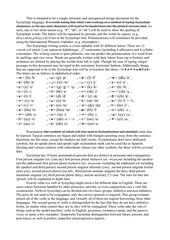
The Syerjchepi writing system is a true alphabet with 43 different letters. There are 12
vowels (of which 2 can represent diphthongs) , 27 consonants (including 4 affricates) and 4 syllabic
consonants. The writing system is quite phonetic, one can predict the pronunciation of a word from
its spelling, and vice-verse. Words are generally written with their letters from top to bottom, and
sentences are formed by placing the worlds from left to right. Though for ease of typing, longer
passages in this document may be typed in the customary horizontal fashion. Additionally things
that are supposed to be in the Syerjchepi font will be in brackets like these <eksampLAsd>.
The letters are as follows in alphabetical order:
<b> (b) /b/
, <p> (p) /p/
, <f> (f) /f/
, <D> (dh) /ð/ ,
<T> (th) /θ/
, <w> (w) /w/
, <y> (y) /j/
, <s> (s) /s/ ,
<z> (z) /z/
, <g> (g) /g/ + /ŋ/ , <k> (k) /k/
, <h> (h) /h/ ,
<r> (r) /ɹ/
, <B> (br) /ʙ/
, <S> (sh) /ʃ/
, <Z> (zh) /ʒ/ ,
<t> (t) /t/
, <d> (d) /d/
, <j> (j) /ʤ/
, <c> (ch) /ʧ/ ,
<x> (x) /x/
, <n> (n) /n/
, <m> (m) /m/
, <l> (l) /l/ + /ʔ/,
<v> (v) /v/
, <q> (ts) /ts/
, <Q> (dz) /dz/
, <R> (hr) /r/ ,
<N> (hn) /n/
, <M> (hm) /m/
, <L> (hl) /l/
, <e> (eh) /ɜ/ ,
<a> (ah) /ɒ/
, <i> (ie) /ɨ/
, <I> (ih) /ɪ/
, <O> (oy) /oɪ/ ,
<A> (ay) /e/
, <U> (uh) /ə/ + /ʌ/ , <u> (oo) /u/
, <E> (ei) /aɪ/ ,
<W> (au) /ɔ/
, <o> (oh) /o/
, <Y> (oe) /ø/
Punctuation (the symbols of which will also need to be handwritten and attached) must also
be learned. Typical sentences are begun and ended with triangles pointing away from the sentence.
Questions are the same, except the markers are half circles. Exclamations don't have dedicated
symbols, but an upside down and upside right exclamation mark can be used like in Spanish.
Quoting and various contexts with subordinate clauses use other symbols, but these will be covered
later.
Syerjchep has 10 basic grammatical persons that are distinct in pronouns and conjugations.
First person singular (ex. I,me,my) first person plural inclusive (ex. we,us,our including the speaker
and the addressed) first person plural exclusive (ex. we,us,our excluding the addressed yet including
the speaker and third parties) second person singular informal (you) , second person singular formal
(also you), second person plural (you all) , third person animate singular (he/she), third person
inanimate singular (it), third person plural (they), and an auxiliary 2.5 case. The uses for this last
'person' will be explained in depth later.
Exactly what is a verb in Syerjchep might seem a bit different than in English. There are
cases where functions handled by other pronouns, adverbs, or even conjunctions use a verb like
construction. Verbs in Syerjchep can be divided into two basic groups, infinitive and non-infinitive.
The prior do not need to be conjugated, only the correct pronoun is required. This group contains
almost all of the verbs in the language, and virtually all of them are regular borrowings from other
languages. The second group of verbs is distinguished by the fact that they do not have infinitive
forms, no matter what context they are in, they will be conjugated. These verbs take the role of
things such as the model/auxillery verbs in English, possision, existance/copula, and the passive
voice, to name a few examples. Temporally Syerjchep distinguishes between future, present, and
past tenses, as well as perfect, imperfect and progressive aspects.
�
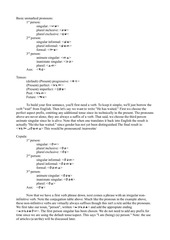
Basic unmarked pronouns:
1st person:
singular: <SU>
plural inclusive: <sU>
plural exclusive: <zU>
nd
2 person:
singular informal: <Ot>
plural informal: <Oti>
formal: <at>
rd
3 person:
animate singular: <in>
inanimate singular: <es>
plural: <ni>
Aux: <Ez>
Tenses:
(default) (Present) progressive: <ku>
(Present) perfect: <mra>
(Present) imperfect: <Wft>
Past: <mri>
Future: <Yv>
To build your first sentance, you'll first need a verb. To keep it simple, we'll just borrow the
verb "wait" from English. Then let's say we want to write "He has waited." First we choose the
perfect aspect prefix, omitting any additional tense since its technically in the present. The pronouns
above are never alone, they are always a suffix of a verb. That said, we choose the third person
animate singular since he is alive. Note that when one translates it back into English the result is
actually "He/she has waited." since gender has not yet been distinguished.The final result is:
<mrawAtin> This would be pronounced /mɹɒwetɨn/
Copula:
1st person:
singular: <AS>
plural inclusive: <As>
plural exclusive: <Az>
2nd person:
singular informal: <Asi>
plural informal: <Asit>
formal: <Asin>
3rd person:
animate singular: <Ast>
inanimate singular: <Asd>
plural: <An>
Aux: <At>
Now that we have a first verb phrase down, next comes a phrase with an irregular noninfinitive verb. Note the conjugation table above. Much like the pronoun in the example above,
these non-infinitive verbs are virtually always suffixes though this isn't a rule unlike the pronouns.
We first take our noun, "person", written <persN> and add the appropiate ending
<persNAS>. The first person singular has been chosen. We do not need to add any prefix for
time since we are using the default tense/aspect. This says "I am (being) (a) person." Note: the use
of articles (a/an/the) will be discussed later.
�
Possesion:
1st person:
singular: <iriS>
plural inclusive: <iris>
plural exclusive: <iriz>
nd
2 person:
singular informal: <irs>
plural informal: <irsi>
formal: <irsin>
rd
3 person:
animate singular: <irut>
inanimate singular: <irat>
plural: <irin>
Aux: <ir>
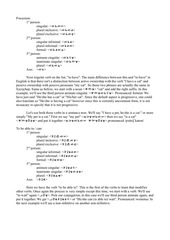
Next irrgular verb on the list, "to have". The main difference between this and "to have" in
English is that there isn't a distinction between active ownership with the verb "I have a cat" and
passive ownership with possive pronouns "my cat". So those two phrases are actually the same in
Syerjchep. Same as before, we start with a noun <kat> "cat" and add the right suffix. In this
example, we'll use the third person animate singular. <katirut> Pronounced /kɒtɨrut/ We
have just said "He/she has a cat" or "His/her cat". Since the default aspect is progressive, one could
also translate as "He/she is having a cat" however since this is extremly uncommon form, it is not
nessacary to specify that it is not progressive.
Let's use both these verbs in a sentance now. We'll say "I have a pet, he/she is a cat." or more
simply "My pet is a cat." First we say "my pet" <petiriS> then we say "is a cat"
<katAst> and put it together <petiriS katAst> pronounced /pɜtɨriʃ katest/
To be able to / can:
1st person:
singular: <BWjiS>
plural inclusive: <BWjis>
plural exclusive: <BWjiz>
2nd person:
singular informal: <BWtsi>
plural informal: <BWtsin>
formal: <BWtit>
3rd person:
animate singular: <BWtsu>
inanimate singular: <BWtist>
plural: <BWtnU>
Aux: <BWd>
Here we have the verb "to be able to". This is the first of the verbs to learn that modifies
other verbs. Once again the process is very simple except this time, we start with a verb. We'll use
"to wait" again <wAt>. Pick our conjugation, in this case we'll use third person animate again, and
put it together. We get <wAtBWtsu> or "He/she can (is able to) wait". Pronounced /wetʙɔtsu/ In
the next example we'll use a non-infinitive on another non-infinitive.
�
To want / to like
1st person:
singular: <matiS>
plural inclusive: <matis>
plural exclusive: <matiz>
nd
2 person:
singular informal: <maqi>
plural informal: <matit>
formal: <maqin>
rd
3 person:
animate singular: <maqu>
inanimate singular: <maqa>
plural: <matWnt>
Aux: <maq>
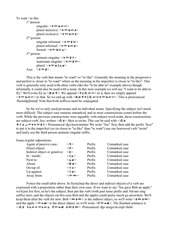
This is the verb that means "to want" or "to like". Generally the meaning in the progressive
and perfect is closer to "to want" where as the meaning in the imperfect is closer to "to like". This
verb is generally only used with other verbs (like the "to be able to" example above) though
informally it could also be used with a noun. In this next example we will say "I want to be able to
fly." We'll write fly as <flE>. We append <BWjiS> to it, then we simply append
<matiS> to that. So we end up with <flEBWjiSmatiS>. This is pronounced
/flaɪʙɔʤɨʃmɒtɨʃ/ Note that both suffixes must be conjugated.
So far we've only used pronouns and no indivdual nouns. Specifying the subject isn't much
more difficult. The subject case remains unmarked, and in most constructions comes before the
verb. While the previous constructions were arguably verb-subject word order, these constructions
are subject-verb. Joe, written <jo> likes to swim. This can be said with <jo
kuswImmaqu> Pronounced /ʤo kuswɪmɒʦu/ We write "Joe" first, then add the prefix "koo"
to put it in the imperfect (so its closer to "to like" than "to want") use our borrowed verb "swim"
and lastly use the third person animate singular suffix.
Some regular adpositions:
Agent of passive cons.:
Direct object:
Indirect object or genetive:
In / inside:
Next to:
About:
On top of:
Up against:
Away from:
<E>
<A>
<o>
<Wn>
<nO>
<cU>
<uv>
<ut>
<ab>
Prefix
Prefix
Prefix
Prefix
Prefix
Prefix
Prefix
Prefix
Prefix
Unmarked case
Unmarked case
Unmarked case
Unmarked case
Unmarked case
Unmarked case
Unmarked case
Unmarked case
Unmarked case
Notice the small table above. In Syerjchep the direct and indirect objects of a verb are
expressed with a preposition rather than their own case. If we want to say "Joe gave Bob an apple."
we'd put Joe first, as he's the subject, then put the verb (with past tense prefix and 3rd-ani-sing
suffix) next, and the objects (in this case Bob and the apple) could pretty much go anywhere. We'll
keep them after the verb for now. Bob <bob> is the indirect object, so we'll write <obob>
and the apple <apL> is the direct object, so we'll write <AapL>. The finished sentance is
<jo mrigIvin AapL obob> Pronounced /ʤo mɹigɪvɨn eɒpl obob/
�
Passive voice
1st person:
singular: <hAS>
plural inclusive: <hATs>
plural exclusive: <hADz>
nd
2 person:
singular informal: <hATt>
plural informal: <hATit>
formal: <hATat>
rd
3 person:
animate singular: <hAf>
inanimate singular: <hAT>
plural: <hATin>
Aux: <hA>
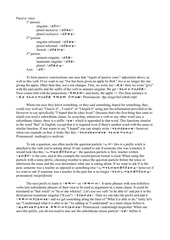
To form passive constructions one uses that "Agent of passive cons." adposition above, as
well as this verb. If we want to say "Joe has been given an apple by Bob." Joe is no longer the one
giving the apple. Other than that, not a ton changes. First, we write Joe <jo> then we write "give"
with the past prefix and the suffix of the verb in animate singular. We get <mrigIvhAf>.
Next comes bob with the preposition <Ebob> and lastly, the apple <> The final sentance is
<jo mrigIvhAf Ebob AapL> Pronounced: /ʤo mɹigɪvhef aɪbob eɒpl/
When one says they know something, or they said something, hoped for something, they
could very well say "I know it" , 'I said it" or "I hoped it" using just the information provided so far.
However to say specifically "I hoped that he (she) lived." (because that's the first thing that came to
mind) you need a subordinate clause. In syerjchep, whenever a verb or any other word uses a
subordinate clause, there is a suffix <vU> which is appended to that word. This functions simular
to the word "that" in English, except that it is required even if there's another word with the same or
similar function. If one wants to say "I hoped" one can simply write <mrihopSU> however
when one expands on that, it looks like this: <mrihopSUvU mrilIvin>
Pronounced: /mɹihopʃʌvə mɹilɪvɨn/
To ask a question, one often needs the question particle <yI> this is a prefix witch is
attached to the verb you're asking about. If one wanted to ask if someone else was a teacher, it
would look like this <yIticRAsin> the question particle is first, teacher written
<ticR> is the core, and in this example the second person formal is used. When using this
particle with a tense prefix, choosing weather to place the question particle before the tense or
inbetween the tense and the core determines what one is asking about. If we want to ask if in the
past, someone was a teacher as opposed to something else <yImriticRAsin> however if
we want to ask if someone was a teacher in the past but is no longer <mriyIticRAsin>
pronounced /mɹijɪtitʃresin/
The next prefix to learn is <kYZ> or <kYZi>. It turns phrases with non-infinitive
verbs into subordinate phrases of their own to be used as arguments in a main clause. It could be
translated as "that witch" or "he or she who(m)". Let's use our verb "to be able to" and put it in the
third person inanimate singular ("It can") <BWtist>. Then we can take the prefix and add it
<kYZiBWtist> and we get something along the lines of "What it is able to do." lastly let's
say "I understand what it is able to do." by adding in "I understand" as a main clause before it.
<UndRstandSU kYZiBWtist> Pronounced /ʌndrstɒndʃə køʒɨʙɔtɨst/ When one
uses this prefix, you do not need to also use the subordinate clause particle <vU> before it.
�
Syerjchep has four cases for nouns. The unmarked is the main case and the only case used so
far in this guide. It is by far the most common, and corrosponds to most usages of nouns in English.
The other three cases are the causitive, partitive, and comparitive. The causitive simply denotes that
the noun in question is the cause of the action taking place. Putting, say, the noun "cat" in the
causitive is equivilent in English to saying "due to the cat" or "because of the cat". The paritive
intuitivly enough indicates that we are talking about a part of the noun in question. What exactly
this means changes a lot based on context, however in a most basic example putting "cake" into the
partitive would mean "some of the/this/a cake". The comparitive case once again is selfexplainitory, it shows that a comparison is being made with the declined noun. Just like before, the
nature of this comparison changes a lot based on context and modifiers. Putting, for example, the
noun "snow" in this case might be like saying "like/as snow is/does". Specifics on each of these
cases will be covered later.
Nouns in Syerjchep are also inflected for number. They can be either singular, dual, or
plural. Singular and dual nouns use the singular conjugations for verbs, not the plural one. (Think
english "There is a pair of birds on my porch." not "There are a pair of birds on my porch." The
declension table for nouns is below:
Noun Declension
Singular
Dual
Plural
Unmarked
N/A
-C.G -> -C.w.eh.Gns
-V.G -> -V.n.w.eh.Gns
-C -> -C.w.eh
-V -> -V.n.w.eh
-C -> -Cv.ie
-V -> -V.ie
-C.G -> -Cv.ie.C.ie
-C.C -> -Cv.Cv.ie
Causitive
-V -> -V.zh.eh.m
-V.nG -> -V.Cv.zh.eh.m
-V.fricitive > -V.C.eh.m
-V.G -> -V.zh.m.eh.Gns
-V -> -V.zh.w.eh
-C -> -C.w.eh.m
-V -> V.zh.ie.m
-C -> -Cv.zh.ie.m
Comparitive
-V -> -V.z.ah
-C -> -C.ah.z.ah
-V -> -V.z.w.ah
-C -> -C.w.ah.z.ah
-V -> -V.z.ie
-C -> -C.ah.z.ie
Partitive
-nG -> -Cu.oh
-C.G -> -Cu.oh.Gns
-V -> -V.l.oh
-V.G -> -V.l.oh.Gns
-C -> -C.w.oh
-V -> V.n.w.oh
-C -> C.oy.l
-V -> V.l.oy
As can be seen on the table, the ending of the noun in question is relevant to the declension.
Some notes on the abbreviations: C = Consonant , Cv = Voice version of that consonant, Cu =
Unvoiced version of that consonant , V = vowel, nG = not G, Gns = non syllabant version of G if
applicable, G = br , x , hn , hm , hl , hr , g (when ng) , j , ch , ts , dz
As an exercise, I'll take "kitten" and put it in the dual, meaning "a pair of kittens". Kitten is
being written as <kItN>. First we look at the unmarked row, then the dual column and note the
forms. As we wrote "kitten" the last letter is 'hn' which is considered one of those "G" letters. So the
correct line to reference is "-C.G -> -C.w.eh.Gns". 't' is the consonant before it, and 'hn' is the G. So
we take the C, add a 'w', add a 'eh' and then change the 'hn' to its non-syllabant form beause it says
"Gns" which is 'n'. The final result is <kItwen> "kitwen" pronounced /kɪtwɜn/
Next, let's write "because of these cats". This is actually simpler, we will be using the plural
causitive. The reference line is "-C -> -Cv.zh.ie.m". <kadZim> The 't' at the end becomes
voiced and then we just add the suffix. It is pronounced /kɒdʒim/
�
Now, to use some declined words in basic sentences. “I am going to be late because of the
weather.” is the next sentence. We're going to take <weDR> weather and put it in the causative
<weDZmer> then we'll say “I will be late.” Note that here we will use the regular infinitive
verb <SpAtN> to mean “to be late” rather than literally saying <lAtAS>. This is an example
of an infinitive not explicitly borrowed from another language. So the final form is
<YvSpAtNSU>. Add the two together and we get the sentence <weDZmer
YvSpAtNSU> Pronounced /wɜðʒmɜr øvʃpetnʃə/
Next, the comparative. We're going to say “My cat's fur is like snow.” Start with my cat
<katiriS> add the “his/her fur” <fRirut> then the comparative of “snow” which is
<snoza> and lastly add the copula to the end. <snozaAst> All together we get
<katiriS fRirut snozaAst> pronounced /kɒtɨrɨʃ frɨrut snozɒest/ Additionally
you could add in an adjective before the 'snow' part. <katiriS fRirut wEtAst
snoza> ( /kɒtɨrɨʃ frɨrut weɪtest snozɒ/ ) now the sentence reads “My cat's fur is as white as
snow.” Note the position of the copula has changed. Comparative nouns, as well as casual and
partitive ones generally avoid being the object, subject, or predicate, and instead act more like
adverbs when they can. Before there was no other choice but to add the copula to the comparative
noun, yet now that we are no longer omitting the predicate object (adjective), we affix the copula to
it.
In that last example, we used an adjective. That being the first time so far in this guide, it
still must be explained how adjectives (and adverbs) actually work in a sentence. First, adjectives
are declined for case, but nothing else. The placement of adjectives relative to their nouns depends
on the place the noun has in the sentence. If it is the subject, then the adjective will precede it. If the
modified noun is suffixed with a non-infinitive verb, the adjective will also proceed it. Otherwise
the adjective will follow it. This includes nouns in other cases and nouns that are the object of
prepositions.
Adjective declensions:
Unmarked: N/A
Causative:
-V.zh.ah.m , -C.ah.m
Comparative: -V.z.uh , -C.ah.z.uh
Partitive:
-V.l.au , -C.au
Adverbs are conjugated in accordance with the verbs they modify. If the verb being
conjugated is infinitive, then the adverb will take on the same exact endings as the verb. If the verb
is non-infinitive, then the adverb will take on the endings it would take on were it infinitive. “I am
walking slowly.” would look like <sloSU walkSU> (Note: walk could be written
<wak> since the 'l' is silent in English. Also note: generally borrowed words drop inflection and
other endings when being imported e.g. slowly → slow)
In Syerjchep negation is a special case. Negating words are not treated the same as other
adverbs. In a method perhaps similar to French, one often needs two different words placed around
a verb or clause to negate it. The basic negation particle is <nen> it goes at the end of the clause
one wishes to negate. <wAtSU nen> means “I am not waiting.” <jom> means “no more” or
“no longer” and is specifically negative, there is no positive meaning for it, yet when using it, you
still need the other particle. <jom wAtSU nen> means “I am no longer waiting.”
Pronounced: /ʤom wetʃə nɜn/
Some of the usages of that 2.5/auxiliary “person” mentioned way back on page one include:
introducing a new object “There is a cat on my couch”, changing the topic noun, some idiomatic
expressions “It is raining.” , as well as forming adjectives. The sentence <katAt
uvtAbLiriS> “There is a cat on my table.” shows the auxiliary of the copula being used to
introduce the cat. The sentence <oSU koldAt> “I am cold.” uses what could be considered a
'dative' construction to communicate the fact the speaker is cold by essentially saying “It is cold to
me” where 'it' is actually the auxiliary case.
�
Must / To be required to
1st person:
singular: <fwIvS>
plural inclusive: <fwIvs> / <fwIfs>
plural exclusive: <fwIvz>
nd
2 person:
singular informal: <fwIsa>
plural informal: <fwIati>
formal: <fwIat>
rd
3 person:
animate singular: <fwIvu>
inanimate singular: <fwIa>
plural: <fwIWnt>
Aux: <fwIq>
Must not / To be prohibited from
1st person:
singular: <doliS>
plural inclusive: <dolis>
plural exclusive: <doliz>
2nd person:
singular informal: <dolsi>
plural informal: <dolit>
formal: <dolin>
rd
3 person:
animate singular: <dolu>
inanimate singular: <dola>
plural: <dIlin>
Aux: <dolt>
There is a clear distinction between “You must not do this.” (You are prohibited from doing
this) and “You must not do this.” (You are not explicitly required to do this) To say the former, use
the second of these two verbs. To say the latter, use the first of the two verbs, and then negate it.
<smokdolu> or <smokdolt> can both mean “One is prohibited from smoking.” or
simply “No smoking” (both the third person animate singular when there's no specified subject, and
the auxillery 'person'/case can translate to the English pronoun “one”) <smokfwIvu> or
<smokfwIq> can mean “One must smoke.” Negating it like so <smokfwIvu nen> or
<smokfwIq nen> means “One is not required to smoke.”
To make (someone do something) / to cause
1st person:
singular: <logiS>
plural inclusive: <logis>
plural exclusive: <logiz>
nd
2 person:
singular informal: <logsa>
plural informal: <logtsi>
formal: <logit>
rd
3 person:
animate singular: <logsu>
inanimate singular: <logast>
plural: <login>
Aux: <lok>
�
To let/allow (someone do something)
1st person:
singular: <NDaiS>
plural inclusive: <NDais>
plural exclusive: <NDaiz>
nd
2 person:
singular informal: <NDain>
plural informal: <NDaini>
formal: <NDaiat>
rd
3 person:
animate singular: <NDau>
inanimate singular: <NDait>
plural: <NDaitin>
Aux: <NDat>
To use the previous two verbs, one generally must invoke that “Agent of passive cons”
preposition from before. The one doing the allowing/letting is the subject, the person being allowed
to do something is the object of the preposition <E> and then the verb that is being suffixed with
“to let” or “to make” or any other verb like those two can take its own direct and indirect objects.
The sentence <gIvNDaiS Eat obob AapL> which means “I will let you give
Bob an apple.” starts with “Give” with the suffix equating to “I let” then has the formal second
person as the object of the preposition, and then has the same two arguments of “give” as before.
The conjunction “and” in Syerjchep can be translated at least two ways. The way to join
subjects and entire clauses is <R> for example <bob R jon wAtni> “Bob and John are
waiting.” However to join objects together one uses a splitting suffix <Y> here is one example
<mrikadiY horsiY dogiiriS> (“I had cats and horses and dogs.”) the verb is
essentially split. You get the tense prefix and any other prefixes the verb phrase has, then the first
noun suffixed with <Y> as the first word, then any middle nouns with no suffixes or prefixes
except for <Y> and then the last (this could be the second if there's only two) noun has the verb
suffix and any other suffixes. This can be used on prepositions as well <gIvSU obobY
jon AapL> (“I am giving Bob and John an apple.”) There is also <i> which can only join
main clauses / sentences together. It could possibly be translated as “and” , “then” or “and then”.
<gIvSU obob AapL i livSU> would mean "I am giving bob an apple and then
I am leaving." <R> may preform this function as well.
Other regular conjunctions:
However/But
Or
So
After
Before
While/As
Unless
Until
<dWx>
<L>
(This can be used like <R> or <Y> )
<QI>
<praxvU>
<BedvU>
<zyovU>
<nenivU>
<gazvU>
Those conjunctions are fairly similar to English in use, but examples will be provided later.
More importantly subordinating conjunctions such as "who", "when", "how" each have multiple
forms and are more different from English. In general, such words have at least three forms, an
interrogative form "Who was just here?" a subordinating form "I don't know who was just here."
and an independent form "I don't know who."
�
 Historical archive . public document