Still readable
in ten years.
A document does not disappear all at once. The medium fails, the software changes, and three copies end up with three different dates. What holds is a format made to last, a kept fingerprint, and a date that no longer moves. On servers in France.
- archive.formatPDF/A · ISO 19005
- archive.fingerprintSHA-512 kept
- archive.datethe upload date
- archive.exitalways open
What makes a document disappear
The medium that fails
An external drive lasts a few years, a USB stick less. The failure gives no warning, and it always comes in the year the document matters.
The file that no longer opens properly
The software changed, a font is missing, the layout shifts. The file is there, but what you see is no longer what you signed.
The doubt you cannot settle
Three copies, three different modification dates. Which one is authoritative? With no fingerprint kept, the question has no answer.
Six things, and not one more
The format that survives
PDF/A is the version of PDF made to last: fonts embedded, nothing that depends on a piece of software being installed. One tool produces it, another checks that a document really conforms. Convert to PDF/A →
The fingerprint that proves it
At every upload the fingerprint of the file is computed and kept. Years later it answers a simple question: is this document exactly the one I uploaded? Compute a fingerprint →
The date that no longer moves
Every document carries its upload date. It is not renegotiated as copies are made, unlike the modification date of a file, which changes as soon as you move it. What a dated document proves →
One place only
An archive scattered across a drive, a stick and two online services becomes a collection of copies, none of which is authoritative. Here everything sits in one place, hosted in France. Security and hosting →
A frozen copy, for what you publish
When you publish a document, a frozen and dated copy goes online. Your original stays private, and what a third party read matches a precise state, on a precise date.
A way out, always open
You take your folders back as downloadable archives, with an inventory that carries the keywords, the descriptions and the fingerprints. An archive is judged by its way out.
An archive you can get out of
It is the criterion nobody looks at when opening an account, and the only one that counts on the day you leave.
The content and its metadata travel together
An archive that gives you back only files gives you back half your work: the keywords, the descriptions and the fingerprints stay with the provider, and what comes out is no longer verifiable. Here every folder archive carries its inventory, in a format any spreadsheet opens. You can leave without losing anything, and that is precisely why people stay.
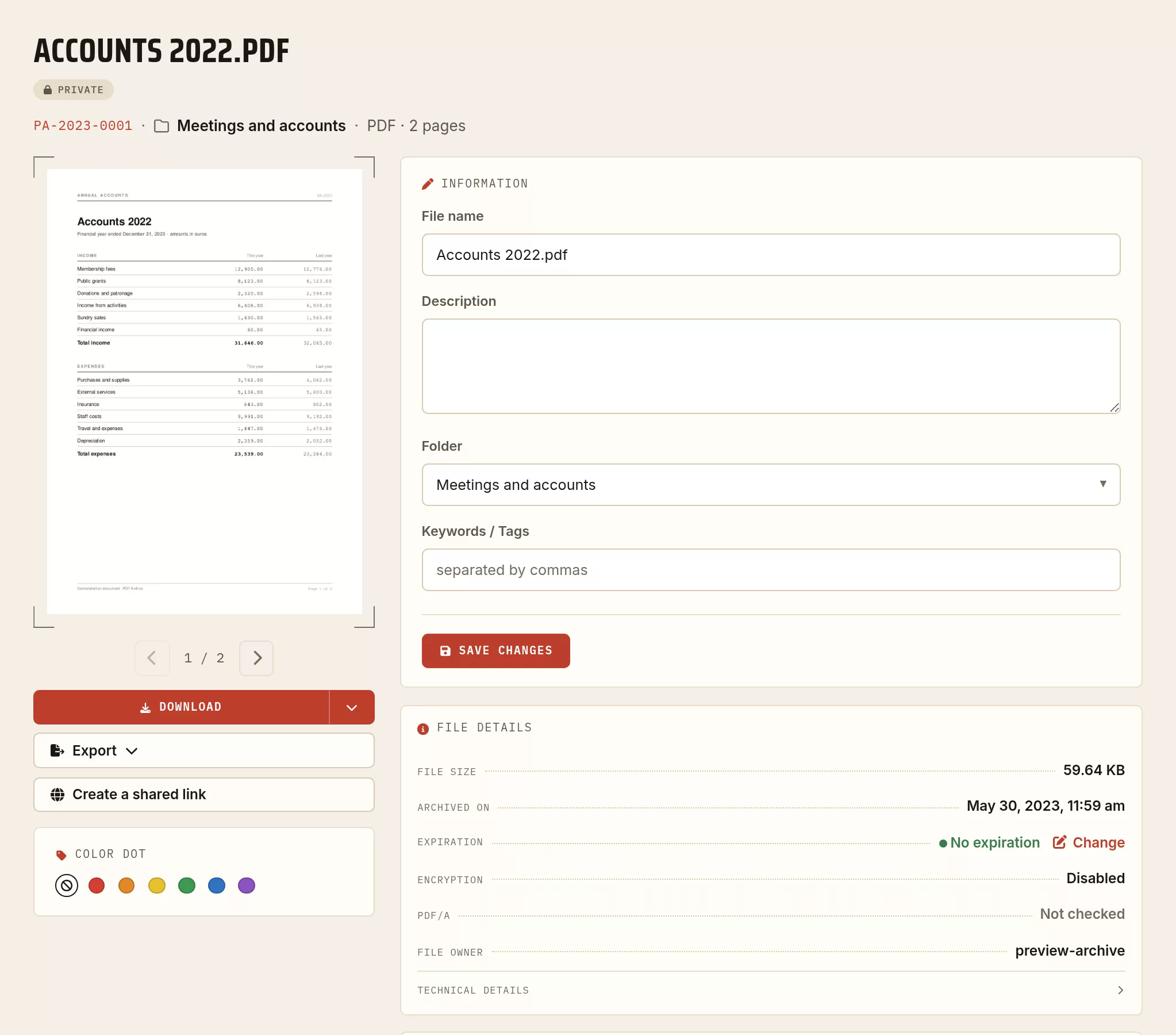
An archive that ages well
The page of a document filed in 2023, captured exactly as it stands in the account area three years later.
Three steps
Upload
The document arrives dated, with its fingerprint, in the folder you want.
Convert what has to last
The documents you will keep for ten years go to PDF/A in one step, from the toolbox.
Check, or take it back out
The fingerprint confirms that a document has not moved. And the day you want it all back, you take it back.
What people ask us
What is PDF/A, and is it really worth using?
It is a variant of PDF designed for preservation: everything needed to display the document is enclosed inside it, fonts included, and nothing depends on software installed on your machine. An ordinary PDF will probably open perfectly well in fifteen years. A PDF/A is made so that this is a certainty. For the documents you have to keep for a long time it is worth doing, and it takes a few seconds.
How do I know, ten years from now, that a document has not been modified?
By its fingerprint. At upload we compute a string that depends on the content of the file: change one comma and it changes entirely. It is kept with the document. You recompute it later and compare. That is what separates an archive from a plain folder of files.
And if I want to leave? Can I get my documents back?
Yes, at any time, and without asking us. You download your folders as archives, and each one contains an inventory that carries the keywords, the descriptions and the fingerprints of your documents. The metadata travels with the files: without it, an archive taken out of the service is no longer verifiable. That is a matter of principle.
Does this replace my backups?
No, and it should be said plainly: an online archive is one more copy, held by somebody whose job it is. Keep your own. The rule that has always held still holds: a document that exists in only one place is a document living on borrowed time, wherever that place is.
How long do I have to keep my documents?
It depends on the document, and the usual periods run from a few years to ten, sometimes longer for a building project or a deed. The point of an online archive is precisely that you no longer have to think about it every year.
Where are my documents, physically?
On servers located in France, operated under the GDPR. For the most sensitive documents you can also encrypt them on upload. The detail is on the security page.
Getting a file ready for the long run
Convert to the standard format, check that a file really conforms to it, and make a scanned document searchable before filing it away.
Convert to PDF/A
The standardized format (ISO 19005) for keeping a document readable for years.
Open the tool →Validate a PDF/A
Check whether a file really meets the archiving standard.
Open the tool →Make a PDF searchable (OCR)
Add a text layer to a scanned PDF so its words can be searched.
Open the tool →To go further
The evidential value of a dated PDF
Timestamping, integrity, admissibility: what a dated upload really proves, and where it stops.
Read the article → SovereigntyGDPR: where are your documents, really?
Hosting, transfers outside the EU, processors: the questions to put to your cloud.
Read the article → FreelancersHow long should you keep invoices and contracts?
Legal retention periods in five countries, each with its official source, and a filing method that survives all of them.
Read the article →Every guide is in the journal of the archive.