The archive of
your practice.
Accounts, contracts, documents: filed, confidential, kept. Passed to your clients through links that last, on servers in France.
- practice.filingby matter, by year
- practice.encryptionGPG · AES-256
- practice.sharingpassword · end date
- practice.hostingFrance 100%
The day a matter comes back out
“The 2020 accounts for this client?”
Filed by financial year, found dated in seconds, then passed to the client through a protected link, without digging it out of a backup.
“You are taking over a colleague’s matter.”
The archive passes across as a block, dated and organised by financial year, instead of a hard drive that eventually goes missing.
“That is covered by professional secrecy.”
GPG encryption on upload, hosting in France, controlled access: what has to stay confidential stays confidential, by default.
Your documents, filed and confidential
Kept and dated
Every upload is dated and kept for as long as you have to keep it. Your documents, filed by financial year, do not go missing.
Confidentiality
Encrypt your files and documents with GPG (AES-256). Professional secrecy, by default.
Passing documents on through a link
Pass a document to a client or a colleague through a protected link, with a password and an expiry date.
Filed by matter and by year
One folder per client or per financial year; everything is found again instantly.
Receiving documents
Take in a client’s documents through a single link, without them holding an account.
Data in France
Hosted in France, GDPR compliant: your data does not leave the EU.
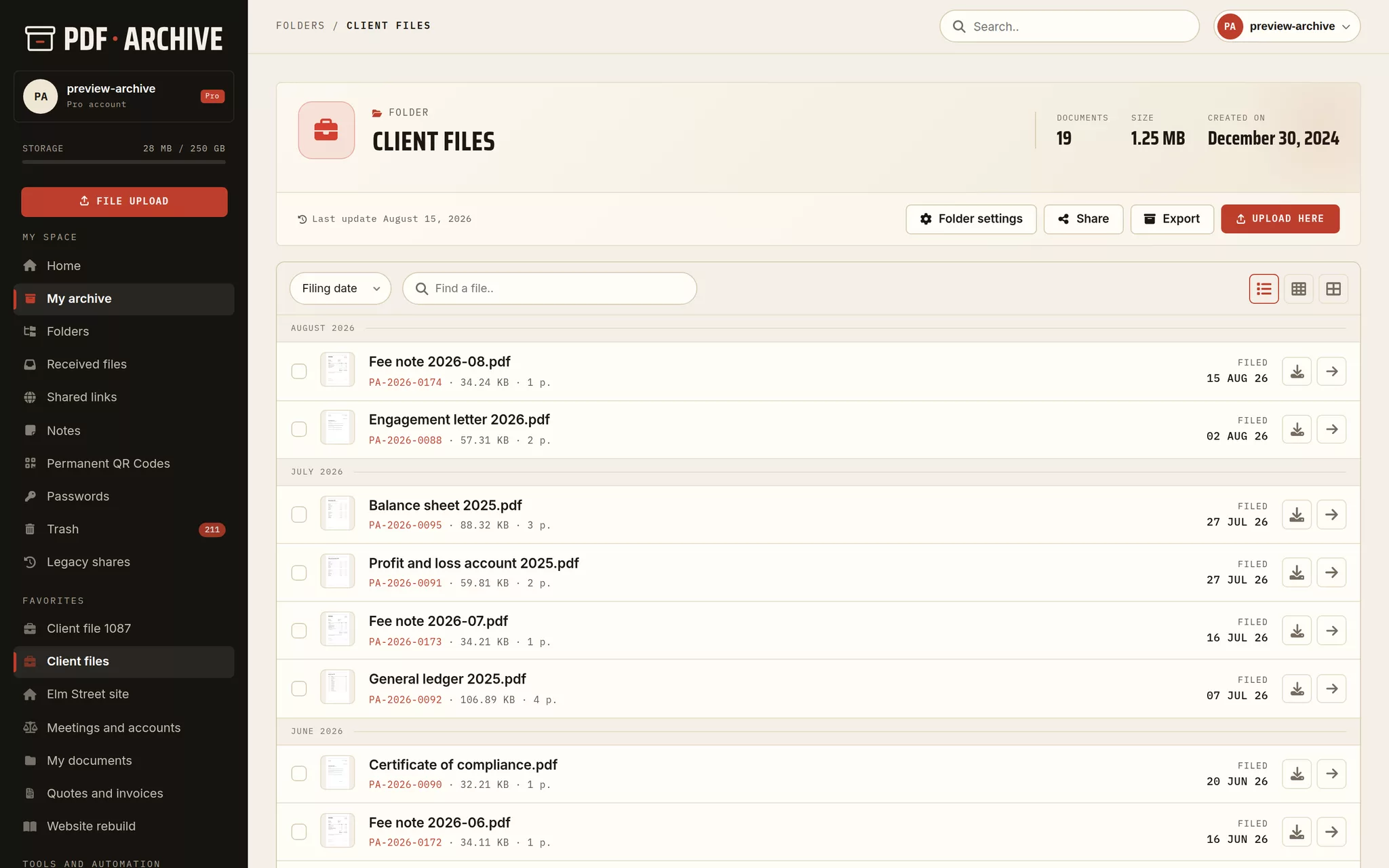
A matter, filed by year
A folder from the demonstration archive, captured exactly as it stands in the account area. The documents are made up for the example; the screen is the real one.

Three steps
Create your space
Free, in a minute.
File by financial year
One folder per client or per year, your documents dated.
Pass it on through a link
Protected, dated, revocable links; you keep the original and the control.
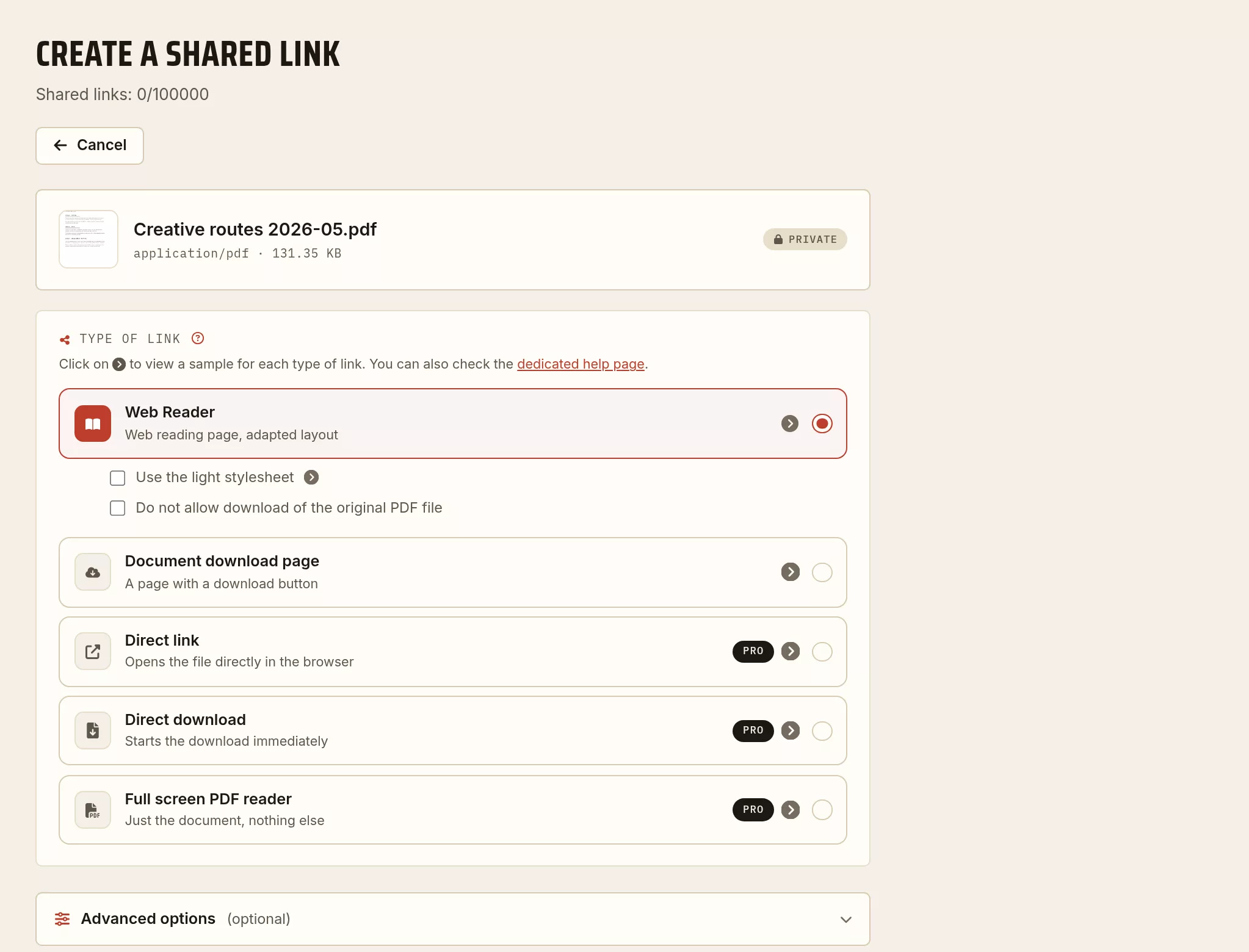
A link that closes again
Sending a document to a client is easy. Knowing, six months later, who can still open it is the part that usually goes missing.
A password
The link alone is not enough to read the document. You pass the password through another channel.
An end date
The link stops working on the day you chose, without you having to remember it.
A single use
The link opens once and closes behind the reader. Handy for a document that concerns one person only.
What people ask us
Does this page apply to a notary, an accountant or a wealth manager?
Yes. The documents differ from one practice to another, the method does not: one folder per client or per financial year, dated documents kept for years, a document passed on through a link rather than as an attachment. Encryption on upload covers what falls under professional secrecy. See security and hosting.
How long do documents in a matter have to be kept?
It depends on the document, and the usual periods run from a few years to ten years. The service does not apply them for you: it keeps, it dates, and it leaves the document in place for as long as you keep it.
Does a document dated here carry evidential value?
It establishes a dated trace. Proof in the legal sense calls for an approved trusted third party. Every public share is a frozen, dated copy, separate from your original, so you know which document was made available and on what date.
Does my client have to create an account to receive a document?
No. They open a link in their browser, read it, download it. You protect that link with a password, you give it an end date, or you close it later. In the other direction, your drop page collects a client’s documents without them holding an account either.
Can I upload health data?
No. The service is not approved for the hosting of personal health data, and article 5 of the terms of use excludes it on every plan, managed dedicated instances included. The administrative documents of a practice, on the other hand, are exactly the use described here.
Preparing a set of documents for a client
Bring the pieces of a matter together into one document, protect it with a password before it goes out, then freeze it in the archiving format.